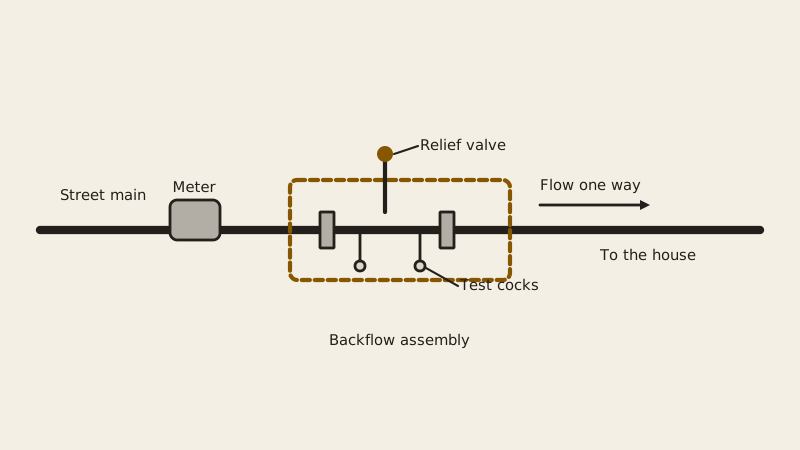
Backflow means water travelling in reverse, out of a property's pipes and toward the public supply, taking possible contamination with it. A backflow assembly is the valve that stops it, and the water district can require it to be tested on installation and every year after. The testing rules sit alongside the wider permits, codes and inspections guide, and a plumber books the test for you through the quote form.
What is backflow, and why does a valve have to be tested?
Backflow happens when water flows against its normal direction. The Cucamonga Valley Water District describes two causes. Backsiphonage follows a sudden pressure loss in the system, for example when a main breaks or hydrants are opened for a fire. Backpressure occurs when pressure on the customer's side is higher than the district's, pushing water back into the supply.
A device can look fine and still fail, since its internal springs and seals wear, and only a recorded test shows it still works. Hence the repeat testing, rather than trust placed in one installation. Day-to-day prevention is simple: an air gap at taps, no hose left sitting in water, and vacuum breakers on hose bibs.
Does my property need a backflow assembly?
The district decides case by case which residential, commercial and industrial customers must install and maintain one. Its assembly page lists multifamily, commercial and industrial sites, properties with an alternate water source, and parcels with irrigation meters. Commercial irrigation systems need approved, testable assemblies.
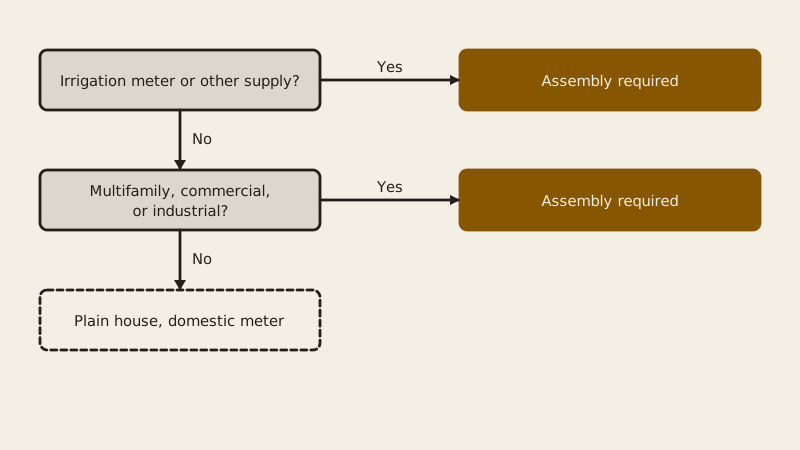
An ordinary single-family house on a domestic meter does not appear on that page. A house could still be covered if it has its own irrigation meter or another water source. The district's backflow department, at backflow@cvwdwater.com, answers address-specific questions. Upland is different: water comes mainly from the City of Upland, with small areas served by others, so look at the bill to identify the supplier and put the backflow question to them.
Business owners should also read commercial backflow testing.
When is the next test due?
Inside Cucamonga Valley Water District territory, an assembly gets tested at installation, annually, and any time it is repaired, replaced or moved. The district also sends customers an annual testing notification, so a notice in your mail is the cue to book. Some high-risk sites may be tested more often, as the testing article describes for some high-risk properties.
Leave slack in the schedule. Repair or replacement has to come before the retest, and parts take time, so booking early protects the deadline. Ask the tester for a copy of the report for your files. Results are filed through the district's online portal, and the tester handles that.
Who may run the test, and can an owner do it?
Inside the service area, only a tester named on the district's approved list may test or repair an assembly. Owning a gauge kit does not change that, and the testing company's article says homeowners cannot do official tests in most jurisdictions. Results go in through the portal, with the original report returned to the district.
When you hire, ask for the tester's name and check it against the district's current approved list, which the assembly page links to. Searches such as "backflow testing certification online" lead to training for testers, not to something an owner can use to test their own device. This page does not say who is credentialed, because we do not hold the list.
The plumbing side is separate. Fixing or swapping a failed device is ordinary plumbing, and a plumber can take it on once the tester has documented the failure. We can arrange that visit.
What does a test cost, and is next-day service realistic?
A backflow testing company reports that most homeowners pay $50 to $150 for the annual test, within a wider $30 to $300 band shaped by location and system complexity. That is a national yardstick. Repairs, a retest after a failed result and any city filing fees sit on top. See the inspection cost page for more.
On timing, ask the tester about availability when you call. No source we checked promises a lead time, so none is stated here, and a next-day slot is something to ask about, not expect. The actual price and date come from a quote in writing, from the plumber or tester you hire.
What follows a failed test?
Nothing passes until the device is fixed or replaced and tested again. Repairs normally replace worn rubber seals, springs or check parts, and occasionally the entire assembly. The testing article says some jurisdictions allow a set period to fix problems, and gives conflicting numbers, so ask the district what deadline applies to you.
Keep the failed report. Tell the plumber the test result and the device's make and size so parts arrive with them. After the repair, a tester retests and files the result.
Does backflow work or gas piping need a permit?
Answers differ by job and by city. A new or replacement assembly is a plumbing job. Under California's contractor rule, a permitted job always counts, and so does any job where labor and parts reach $1,000. An owner cannot assume the right to pull the permit personally, since rules differ and not every job qualifies. Phone your city's building division first and wait for an answer.
Rancho Cucamonga takes permit applications through its Online Permit Center, with Building and Safety at 10500 Civic Center Drive. Upland's Building and Safety Division sits at 460 N Euclid Avenue and also takes applications online.
Gas is a separate matter. Residential gas piping is governed by code and belongs to a contractor, and SoCalGas is the utility for service questions. The gas line page goes further. Smell gas? Get out first. Use 1-800-427-2200 for SoCalGas from outside, and dial 911 when anyone is at risk.
Common questions
How long is the tester at the property?
A single residential device is generally a short stop, but a fail result brings repair time and then a retest. Report filing comes with the job in most cases, so confirm that when you book. Reserve a slot early in the notice period so a repair cannot push you past the district's date.
Which questions go to a tester first?
Whether the tester is named on the district's approved list, the fee per device, who files the report with the district, what a retest costs and who does repairs. Keep every price in writing ahead of the visit. The home page explains how plumbers get arranged.
Does the test need someone at home?
Yes, because the tester has to reach the device, which may sit near the meter, in a yard box or on the irrigation line. Water is interrupted briefly, so warn the household. At a business, someone should open access to every device.
Is a plumbing permit something an owner can obtain?
Sometimes, depending on the city and the work. Permitted work is tied by state rules to a contractor license, with some exceptions, and Rancho Cucamonga and Upland run their own permit offices. Check with the relevant division early, and find out if the plumber's price includes the permit.
Updated