Close the main, flip the breaker for that room, and set a bucket beneath the drip. After that, work out the source: a pressurized pipe, a drain, the roof or the air conditioner. Closing the main is the fastest test, because a pressurized line quits dripping once it is shut. The broader subject is on the leaks and burst pipes page.
What comes first when the ceiling is dripping?
Turn off the main, then kill the room's breaker, since water and wiring are a bad mix. Move furniture and valuables, put containers under each drip, and photograph before you clean. A bulging ceiling is heavy with water, so keep your head and body out from under it.
A few rules for the next ten minutes:
- Leave water-filled fixtures alone. A ceiling light holding water is an electrical hazard even with the switch off.
- Treat a bulge with care. Contractors often suggest a small hole at the bulge's lowest point so the water drains in a controlled way, with power off and you standing to one side. If you are unsure, wait for help.
- Open one faucet after closing the main, so the pipes empty and the leak runs out sooner.
- Shoot photos and a short video for the insurer, and keep wet materials for the adjuster if you can.
If a pipe has split, the first hour is laid out in emergency plumber for a burst pipe, and the wider checklist is under plumber emergency.
Where is the ceiling water really coming from?
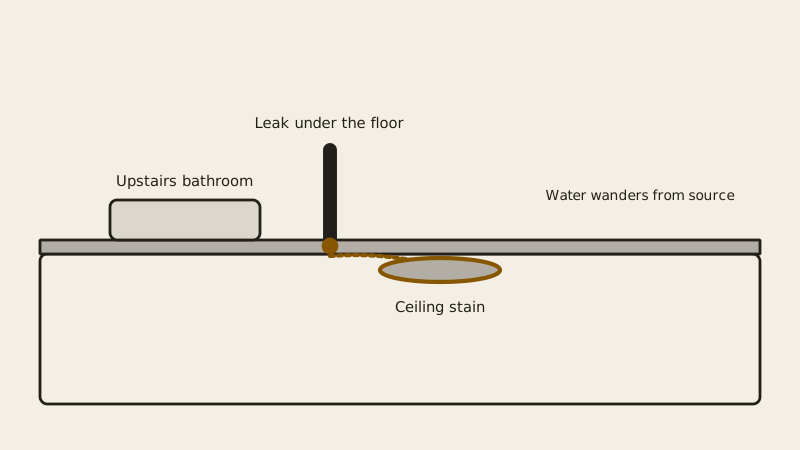
Water wanders, so the stain is rarely directly under the source. Study what is above: bath, kitchen, laundry, attic, roof or an air handler. Then watch timing. Growth after showers or a washer cycle implicates a supply or drain line, growth during rain implicates the roof, and growth while cooling runs implicates the condensate line.
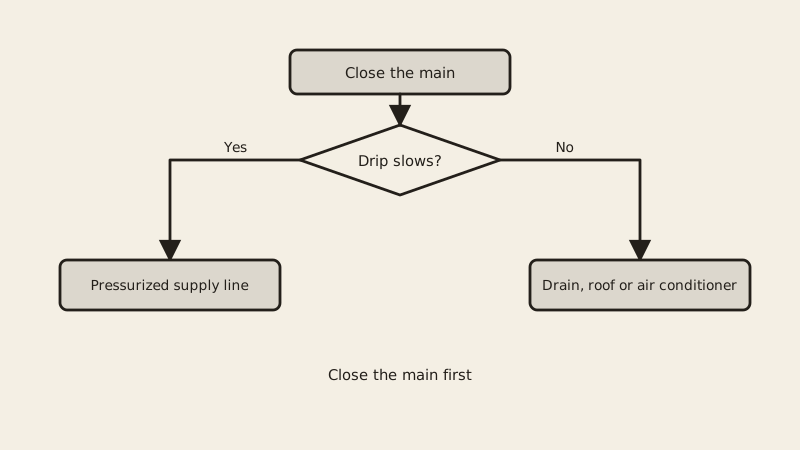
Here is a sorting test. Close the main and wait a few minutes. Dripping that slows points to a supply line; dripping that carries on points to a drain, the roof or the air conditioner. You can also read the meter with every tap off: a moving dial means pressurized water is escaping somewhere.
Smaller clues help. A warm stain hints at hot water; a brown stain with an odor hints at a drain. In any two-story house with a bathroom over a living area, the shower pan, tub drain and toilet seal are prime suspects, covered in plumber for shower leak and repair toilet leak.
Plumbers can use acoustic or thermal tools to locate a hidden leak, so the wall is opened once instead of several times.
Is it a burst pipe, and how long is the repair?
A burst pipe sends steady water through the ceiling until the main is closed. The repair means finding the break, cutting out the damaged length, fitting new pipe, and pressure testing. I cannot verify a typical duration, so request an estimate from the plumber; repairing the ceiling afterward is a separate job.
Plenty of parts can fail: a pinhole in older copper, a PEX fitting, a braided connector, a weeping joint. Pipe type varies with the age of the home. Copper pinholes get their own page, repairing a pinhole leak in copper.
A burst pipe that floods rooms is also an insurance matter. Photograph, start drying, and phone your insurer early. Hold on to the failed section, since the adjuster and the plumber may both want it.
Which sealant works on a leaking pipe or joint?
None is a lasting cure for a pressurized supply line. Epoxy putty and self-fusing silicone tape may slow a small leak for a while, while joint compound and thread tape go on when a threaded joint is assembled, not over an existing drip. Count any sealant as a stopgap until a real repair happens.
For a pinhole or a weeping joint, the usual temporary routine is: drain the line, because putty will not grip a wet pipe; clean and dry the spot; press on epoxy putty or wind self-fusing tape tightly; then watch it. A rubber-padded pipe clamp is another stopgap.
Joints weep for a reason, such as a worn washer, a cracked fitting, corrosion or movement. Snugging may stop it; if not, replace the part. Never use a sealant on a gas line or tape over a relief valve. If you smell gas, get everyone out and ring SoCalGas on 1-800-427-2200 from outside, or 911 if they cannot be reached.
With the pipe inside a ceiling, sealant is the second question. The first is stopping the water and finding the source.
Can mold grow after a ceiling leak?
Yes, when materials stay wet. The EPA's advice is to fix plumbing leaks quickly and dry items completely. Its page says absorbent materials like ceiling tiles and carpet may need to be discarded if mold sets in, and that patches under roughly 10 square feet can usually be cleaned by the homeowner.
Bigger areas or repeated soaking call for professional help, and the EPA points to separate guidance for larger growth. Wet drywall is often cut out if it sags, stains spread or it smells musty. Dry the room with fans and open windows, and photograph stains to see whether they grow.
Do not paint a damp stain. It bleeds back through, and trapped moisture gets worse. Wait for a dry surface and a repaired source, then use a stain-blocking primer.
What will the repair cost, pipe and ceiling both?
In its pipe repair guide, Thumbtack shows $234 to $771 nationally for a burst pipe, $228 to $752 for a leaking pipe, and one California pro quotes $150 for a half-inch copper pinhole repair and $240 for a one-inch line. Its water damage guide shows $500 to $1,000 for ceiling water damage repair and $5 to $8 a square foot for sheetrock.
| Item | National figure | Source |
|---|---|---|
| Burst pipe repair | $234 to $771 | Thumbtack |
| Leaking pipe repair | $228 to $752 | Thumbtack |
| Pinhole leak in copper, one California pro | $150 (half-inch) to $240 (one-inch) | Thumbtack |
| Ceiling water damage repair | $500 to $1,000 | Thumbtack |
| Sheetrock replacement | $5 to $8 per square foot | Thumbtack |
Expect two bills: the plumber for the source and a contractor for the ceiling. Wet insulation, a larger area and a textured finish raise the second. All of this is guide data, and your real number is whatever the local written quote says.
What changes for a lower-floor ceiling or a rental?
A leak through a basement or lower-floor ceiling usually starts on the floor above, in a bathroom, kitchen or laundry, and the same sorting test applies. In an apartment, notify the landlord or manager in writing at once and keep a copy. The owner generally controls shared pipes, so do not open walls yourself.
California sets habitability rules for rentals, so ask how and when the repair will happen and take dated photos. Renters insurance may cover belongings. For your exact rights, a legal aid group or state tenant resources beat a plumbing page.
If the water comes from the unit above, its shutoff may be what stops it. Close your own fixtures, tell management who lives upstairs, and never enter another unit yourself.
Common questions
How soon will the ceiling be dry and repaired?
That hinges on source and damage. Stopping a supply leak can go fast once it is located, whereas wet drywall and insulation take days to dry, and finishing work waits for dry materials. I cannot verify exact times, so get separate estimates from the plumber and the ceiling contractor.
Which questions go on my list for a ceiling leak?
Verify a contractor license number at cslb.ca.gov. Then find out how the leak will be located, whether opening the ceiling is included, whether the quote covers pipe only or drywall as well, and whether a permit applies. Put it all on the written quote.
Will I have to stay home for this?
Plan on it. An adult should greet the plumber, point out the stain, shutoffs and rooms above, and approve the written scope. Clear the space under the leak, mention pets or gates when you request the visit, and leave the main closed until the plumber arrives.
This guide is one of many on Cucamonga Peak Plumbing plumber.
Updated