Closing a valve beats every other first move. Find the main, turn it, and only then start phoning around. Gas is the exception: walk outside and phone the utility. For anything else, use the quote form and a local plumber visits you on a weekday. Browse the home page for the other jobs we set up around town.
When is a plumbing problem a real emergency?
Water, gas or sewage that keeps escaping after you have used the valve nearest to it, or any leak that endangers someone, is an emergency. Examples: a supply line spraying, an ongoing drip through a ceiling, sewage rising in several drains, a water heater leaking while the relief valve runs hot, or no water anywhere in the house.
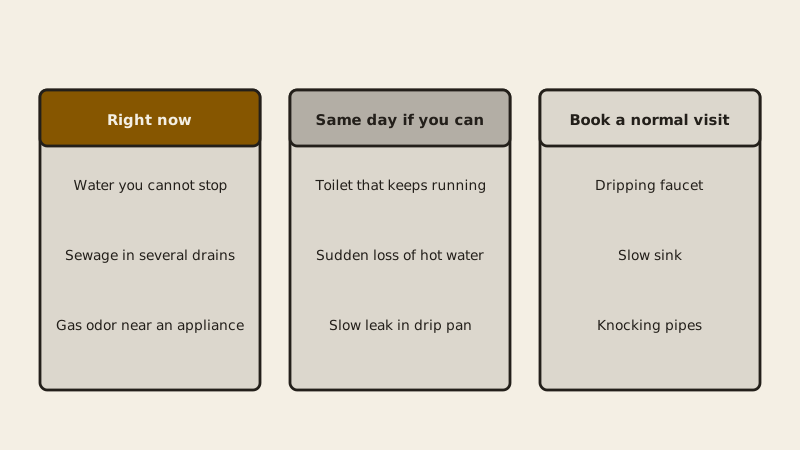
Sorting a call is easier with three buckets.
- Right now: spraying or pouring water you cannot isolate, sewage in more than one drain, a gas odor near an appliance, a stained ceiling that is getting bigger by the hour.
- Same day if you can: a toilet that keeps running, one clogged drain in a home with a second bathroom, a slow leak into a drip pan, sudden loss of hot water.
- Book a normal visit: a dripping faucet, a slow sink, a wobbly toilet, pipes that knock.
Water through drywall gets its own write-up in ceiling water leak, and a split line is handled step by step in the burst pipe emergency guide.
Which problems can wait until morning?
Anything a small shutoff fully stops can be left until a weekday appointment. Stops under sinks and behind toilets, and the cold valve on the water heater, were installed for this purpose. A trickle into a bucket, a clog in the spare bath and lukewarm showers can all sit overnight.
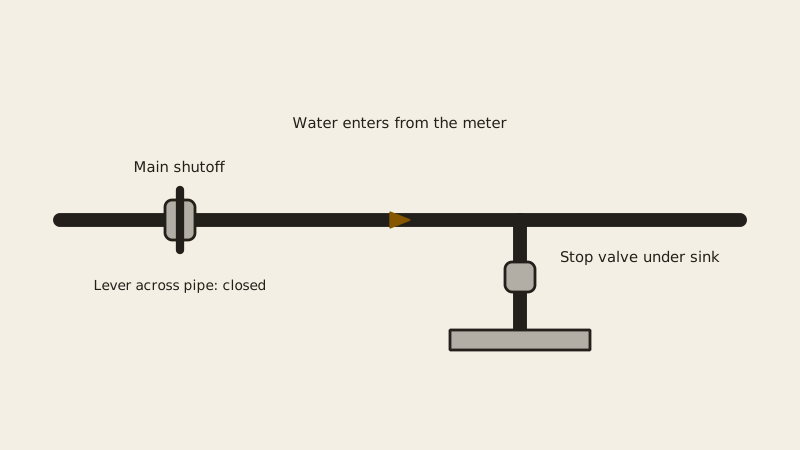
The trouble starts when you cannot find the valve. Locate the whole-house shutoff this week while nothing is wrong. Placement varies by house: beside the hose spigot, inside the garage, or at the meter box near the curb. A lever shuts when it sits crosswise to the pipe; a round wheel handle turns clockwise.
Test a tap afterward, then tie a bright tag to the handle so a guest or a teenager can find it. When pressure vanishes everywhere at once, ask next door whether they lost it too before blaming your pipes; sudden low water pressure explains the rest.
Is round-the-clock plumbing available here?
No, not from us. Requests are read Monday to Friday, 9am to 5pm, and I will not promise an arrival window. If a pipe gives out on a weekend, close the main, crack the lowest faucet so the pipes empty, and submit your request when the office opens.
Spend that first hour on damage control: cut power to an electric water heater at the breaker or turn a gas unit to its off setting, get rugs and electronics off wet floors, and take photos of every stain for the insurer. Run fans over wet spots.
Some businesses do advertise round-the-clock service and charge after-hours rates, shown below. Whoever you phone, ask how the price is built before a truck rolls.
How much does an emergency plumber cost?
Thumbtack's national figures run about $90 to $147 an hour for emergency work, averaging $125, with middle-of-the-night calls sometimes doubled. A plumbing company's price guide shows $120 to $300 an hour on weekday evenings and $200 to $500 on holidays or overnight. None of these is a Rancho Cucamonga quote.
| What | Figure | Where it comes from |
|---|---|---|
| Typical emergency hourly range | $90 to $147, average about $125 | Thumbtack |
| Emergency rates on another Thumbtack page | $135 to $190 | Thumbtack |
| Weekday after hours | $120 to $300 an hour | Paul Bunyan Plumbing |
| Holiday or overnight | $200 to $500 an hour | Paul Bunyan Plumbing |
| Burst pipe repair, national average | $234 to $771 per job | Thumbtack |
Time of day drives the bill most, with multipliers of two to three on some price lists. Next comes what lies behind the wall: a plumber who must cut drywall or lift flooring bills for that access. Plenty of simple repairs go out at a flat rate; find out whether your figure is flat or hourly, and whether the trip fee is credited once you hire.
Your own price shows up only on a written quote for your house.
At what point does weak water pressure need a plumber?
Make the call when pressure falls throughout the house, when just the hot side is weak, or when weak flow arrives with damp patches, stains or a meter still spinning. A single weak faucet is usually a clogged aerator. Pressure that is too strong is a code matter: CPC 608.2 limits fixtures to 80 psi, which a regulator handles.
Before dialing, run through four checks: is the main handle fully open, is the problem at one fixture or all of them, does the meter creep with every tap closed, and did anyone work in the street or the house right before it began.
A high gauge reading usually means a regulator, sometimes with an expansion tank added. A low one could mean a worn regulator, a corroded line or a concealed leak. Have the number written on the quote. The longer story sits in plumber for low water pressure.
What should I do about a gas smell?
A plumber is not your first call. Exit the house without flipping switches or using a phone inside, then ring SoCalGas on 1-800-427-2200 once you are outside. Dial 911 if that fails or anyone is in danger. Gas piping is contractor work here, and the utility makes the line safe first.
That number also takes carbon monoxide concerns. Later repairs can need a permit from the city's Building and Safety office. Plumber gas line shows what such work involves, and the earthquake gas shutoff valve page shows where your shutoff sits.
Never relight a pilot after a suspected leak. Keep generators, flames and sparks away. A gas water heater that has been soaked or has a scorched vent stays off until someone inspects it.
What can I do before anyone arrives?
Three jobs: stop the source, protect the house, record the damage. Close the main, switch the heater off, kill breakers to soaked rooms, and empty the lines at the lowest tap. Slide foil or blocks under furniture legs, move small valuables, and take photos before wiping.
Save the broken part. The plumber can often read the cause from it: a pitted elbow, a cracked braided connector, a joint that let go. Houses here run from the 1960s into the 2000s, so a failed piece could be older copper, newer PEX, or a fitting between them, and the repair differs for each.
Even small leaks matter. The EPA's WaterSense program says a typical household loses more than 9,300 gallons a year to leaks. Tell your insurer promptly, since a late report can complicate a claim. Skip chemical drain opener on a backed-up line: whatever remains in the trap can splash the person who opens it.
Is my leak an air conditioning problem or a plumbing problem?
Air conditioning can wet a ceiling when its condensate drain clogs or the pan overflows. That water is not under pressure. Watch whether the dripping only grows while the system runs; if it does, switch the air conditioning off and call an HVAC contractor, because refrigerant work is a separate trade.
Water that appears with the unit off, water that feels warm, or a stain that spreads fast points to a pressurized pipe. Close the main and see if the stain slows. When an air handler sits in the attic, tell the plumber where the stain first showed.
Condensate lines sometimes tie into a waste line, which is when plumbing scope starts. Describing exactly when the water shows up saves a wasted trip.
What should I check before hiring someone in a rush?
Request a contractor license number and look it up at cslb.ca.gov, the state contractors board. A contractor license becomes mandatory in California at $1,000 of labor and materials, or whenever the job needs a permit. Ask what the trip fee buys and how the rest is priced.
For home work of $500 or more, you are owed a written contract. California law generally caps a deposit at 10 percent or $1,000, whichever is less, though you should confirm current limits with the CSLB. Be cautious about anyone asking for a pile of cash before starting.
The name on the business card should match the name on the quote. Get the scope described on paper before drywall comes off, and pay in a way you can trace. A business ending in LLC should hold the license under that exact name.
Common questions
Is 911 ever right for a plumbing problem?
Yes, in a few cases: gas odor when SoCalGas is unreachable, fire, sparks, water touching live wiring, or an injured person. An ordinary burst pipe or clogged drain is not a 911 call. Close the main for those. The utility gas line is 1-800-427-2200.
How to know if a plumber is good?
Start with a contractor license that checks out on the CSLB site. Then look at the quote: it should separate labor, parts and trip fees. A good plumber explains why the part failed, shows it to you, and keeps the scope clear instead of pushing a bigger job at the door.
How to find an honest plumber?
Confirm the license, request the figure on paper, and compare it with the ranges in the table. Be wary when the price jumps on arrival, when a big cash deposit is demanded, when a license number is withheld, or when a code violation is claimed with no section named.
What does a burst pipe repair run?
Thumbtack's national average range for burst pipe repair is $234 to $771, with a low end near $98 and a high end near $1,905. After-hours timing, wall access and cleanup can push it up. Treat that as a guide, since only your own quote counts.
How many years does becoming a plumber take?
The Bureau of Labor Statistics describes a typical four to five year apprenticeship, with about 2,000 hours of paid on-the-job training each year plus classroom study. Most states, California included, also require a license, which usually involves documented work experience and an exam.
Sources used
- Thumbtack, emergency plumber cost guide
- Thumbtack, drain cleaning prices (emergency multiplier)
- Thumbtack, pipe repair cost (burst pipe figures)
- Paul Bunyan Plumbing, average plumbing repair costs by timing
- SoCalGas, what to do about a natural gas leak
- US Bureau of Labor Statistics, plumbers, pipefitters and steamfitters
- California Contractors State License Board, hire a contractor
- EPA WaterSense, Fix a Leak Week
Updated