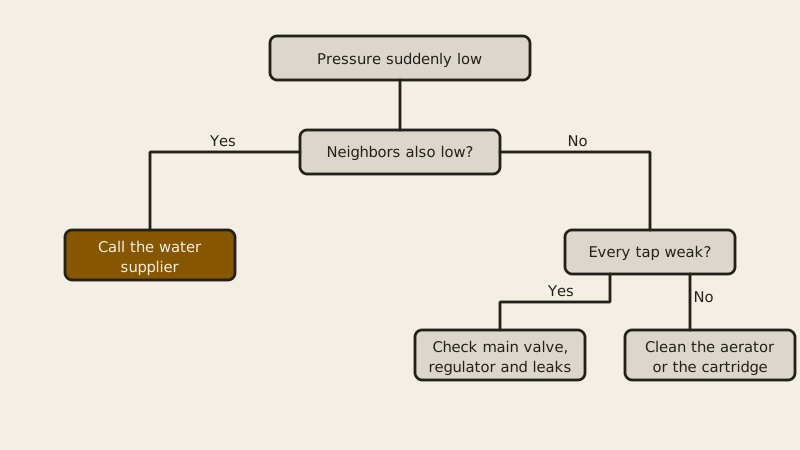
Pressure that falls suddenly, rather than fading over months, points to something that changed: a supplier repair, a valve that got bumped, a regulator that failed, or a break in a pipe. Start with the quick checks that cost nothing. This page belongs with the wider guide to low water pressure and is written for homes in Rancho Cucamonga, Upland and the foothills.
Why did my water pressure suddenly drop?
The usual suspects are, in rough order of likelihood: a supplier outage or main repair in your street, a partly closed main valve or meter valve, a failed pressure regulator, a leak somewhere between the meter and the house, or a blocked filter or fixture. A sudden drop in the whole house is rarely a single dirty faucet.
A quick sort helps:
- Every tap is weak, hot and cold: supplier, main valve, regulator or a leak.
- Only hot water is weak: the water heater, its valves or a scaled line.
- Only one fixture is weak: the aerator, cartridge or a supply stop. See low shower pressure.
- Neighbors have the same problem: most likely the supplier.
Is it my water supplier or my house?
Ask a neighbor, then check your supplier's outage notices. If the street is affected, call the supplier. The Cucamonga Valley Water District says it is responsible for the service line from the street main up to and including the meter, and you are responsible from the meter to the house.
So the line to call depends on where you live. Most of Rancho Cucamonga is in the Cucamonga Valley Water District, which lists 855-654-2893. Much of Upland is served by the City of Upland, whose report gives Public Works at (909) 291-2930. Both districts also reach into parts of other areas, and a few Upland streets are served by other companies, so check your bill for the name of your supplier. San Antonio Heights is served by the San Antonio Water Company.
If the pressure drop is on the supplier side, you may see it in a whole block. If the neighbors are fine, the cause is on your property.
How do I check the main valve and the meter?
Find your main shutoff, usually a ball valve with a lever near the front of the house, or a wheel handle. The lever should sit in line with the pipe when open. A valve left half-closed after repairs, or one that was bumped, can cut pressure sharply. Open it fully, then check the meter valve if the district allows.
If your main is a round gate valve, turn it counterclockwise until it stops, then back it a quarter turn. Do not force a valve that will not move and do not touch the utility's valve at the meter, since that is the district's equipment. If a valve is stiff or leaking, a plumber can replace it, and the page on water pressure and valves explains the options.
Could a failed pressure regulator cause it?
Yes. Many homes have a pressure regulator, a bell-shaped valve near the main, that reduces street pressure for the house. When it fails it can drop pressure to a trickle, or it can fail the other way and let in too much. California Plumbing Code section 608.2 sets 80 psi as the limit for pressure at fixtures.
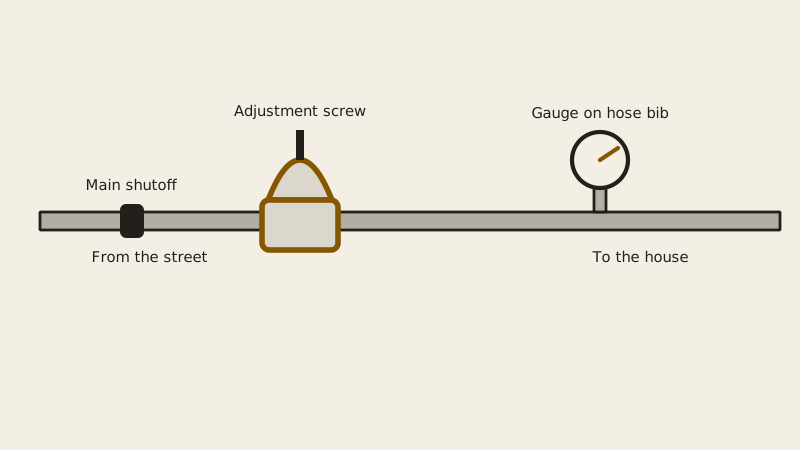
A gauge screwed onto a hose bib or washing machine valve shows the reading. A healthy range is generally below that 80 psi limit, and a sudden low reading with a strong supply points at the regulator. The Cucamonga Valley Water District notes that when a regulator is installed on the property the customer is responsible for its upkeep. See how to adjust a pressure regulator valve and regulator replacement prices.
Higher ground generally means higher street pressure, and homes on the northern slopes may have regulators for that reason, but I have no verified pressure figure for any foothill street.
Could a hidden leak be draining the pressure?
Yes. A leak between the meter and the house, or inside the walls or slab, can lower pressure while the meter keeps running. Close every tap, read the meter, wait two hours and read it again. The EPA says that if the reading moved, you probably have a leak.
The EPA also reports that the average household loses more than 9,300 gallons a year to leaks. Other signs: a wet patch in the yard, a lawn that is greener in one strip, the sound of water in the walls, or a jump in the bill. Read how to know if a pipe burst for the full checks. Close the main if you find water running, and book a plumber.
What other causes should I rule out?
Clogged aerators, shower heads and cartridges, a blocked filter or whole-house screen, a partly closed supply stop, an old galvanized pipe that is narrowed inside, a failing water heater valve or a water softener bypass. Each is simple to check, and several are fixable at home.
Hard water leaves scale. The Cucamonga Valley Water District's 2025 report lists total hardness averaging about 125 ppm, and older steel pipe can fill with mineral buildup and rust. Homes with galvanized supply lines are the likeliest to lose pressure over time, and the page on galvanized pipe replacement explains when replacement makes sense. A banging pipe when you shut a tap is another sign of pressure issues, covered in water hammer.
Unscrew the aerator on a weak tap and rinse it. If the flow returns, that was it. If you have a filter housing or softener, bypass it for a minute to see whether pressure recovers.
When should I call a plumber?
Call when you have checked the supplier and the main valve and the whole house is still weak, when the regulator is suspected, when a leak shows on the meter, when a valve is stuck, or when old pipe may be the cause. Do not open walls or cut pipe yourself unless the work is within your skill and the law.
A plumber can test pressure with a gauge, inspect the regulator and valves, and find a leak with listening gear or a camera. We arrange a visit and the price comes in writing first. Use the quote request, and if water is running, close the main first. The written quote from a local plumber sets the real price, and California requires a contractor license for jobs of $1,000 or more in labor and materials or any job that needs a permit.
Common questions
How long does it take to fix sudden low water pressure?
A supplier outage can last hours. A stuck valve or clogged aerator takes minutes. Replacing a pressure regulator is often a few hours. Finding and repairing a hidden leak, or replacing old pipe, can take a day or more, depending on access and permits.
What should I ask before I hire someone to fix low water pressure?
Ask for the contractor license number and look it up on the state board's site. Ask how pressure will be tested before and after, whether the price covers the regulator and any permit, and what happens if the problem turns out to be a leak or old pipe. Get it in writing.
Do I need to be home for a low water pressure repair?
Yes, at least at the start, to show the main valve, the meter and the weak fixtures, and to approve the price. The water is shut off during the work, so plan around that. Keep the area around the main shutoff clear so the plumber can reach it.
For the wider picture, start with Rancho Cucamonga plumber.
Sources used
- Cucamonga Valley Water District, FAQ (service line and pressure regulator responsibility)
- EPA WaterSense, Fix a Leak Week (meter leak test, leak figures)
- City of Upland, 2024 Consumer Confidence Report (supplier contact)
- Cucamonga Valley Water District, About Us
- California Contractors State License Board
Updated