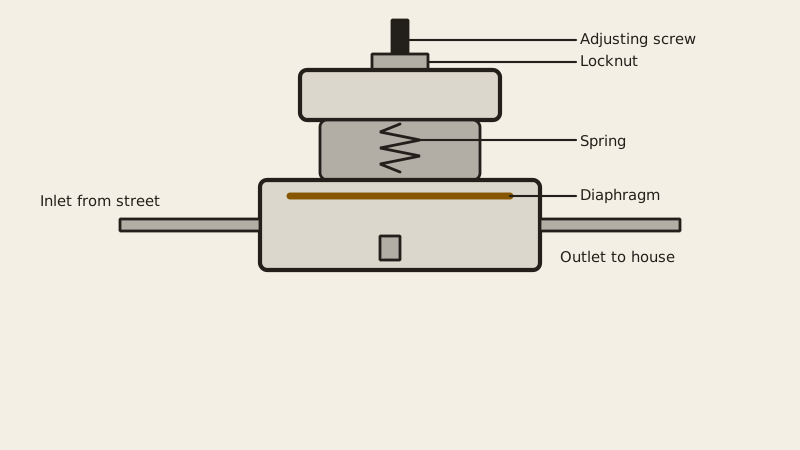
The job in one breath: screw a gauge to the outside spigot, write down the resting number, free the locknut on the regulator's dome, and nudge the screw beneath it by quarter turns, retesting each time. Right raises the number, left lowers it. Lock the nut at your target. Trouble running the other way, a trickle instead of a blast, is covered on the water pressure and valves page.
What pressure should the gauge show?
A resting reading between 45 and 60 psi is the usual goal. A valve-maker's guide treats 80 psi as a ceiling to stay under, never a goal, and says most units ship set between about 45 and 55. California Plumbing Code 608.2 limits fixture pressure to 80 psi, so a higher gauge number breaks code and strains pipes alike.
Record two numbers. Static means every tap closed; flowing means a tap or two running. A dip between them is normal. When the resting figure already lands in the 40s or 50s and showers feel fine, the screw should stay untouched.
Readings drift across the day as well. A spike before sunrise that sags by afternoon suggests heated water expanding inside a closed system, and that is an expansion tank question, not a reason to turn the screw down.
How do I adjust it, step by step?
Keep the supply on. Slacken the locknut on the regulator's housing without taking it off. Rotate the adjusting screw by a quarter at each step. After every turn, crack a tap and shut it again so the gauge settles, since a regulator only lets downstream pressure fall when water leaves the pipes.
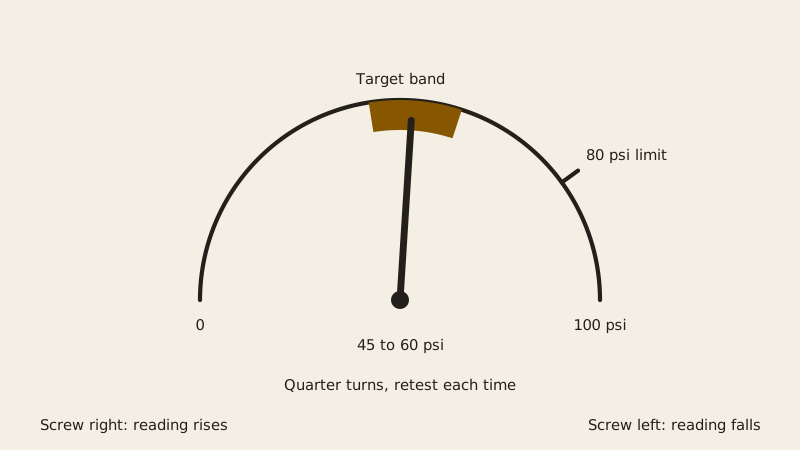
- Thread a 3/4-inch hose-bib gauge onto an outdoor cold-water faucet and note the resting reading.
- Loosen the locknut. Hold the screw still while you turn the nut.
- Quarter turn, bleed a little water, read the gauge.
- Repeat until the needle sits in your band.
- Snug the locknut to keep the setting.
- Run a tap on the upper floor and another farthest from the entry.
Stay inside the spring's rated range. Forcing the screw past its limit can tear the diaphragm. Confirm too that the device is the domestic water regulator on the incoming line, and not a gas regulator, an irrigation valve or a water heater's relief valve.
Where do I find the regulator?
Trace the supply pipe back to where it enters the building. Near the main shutoff, a hose bib or a garage wall is common. The regulator looks like a squat brass bell with a screw and locknut on its crown.
Some live in a box in the ground near the meter, and some houses never had one. A plumber can settle the question in minutes. One boundary matters: the Cucamonga Valley Water District says the customer owns the service line from meter to house and maintains any regulator on the property, and the street side is the district's job.
Will a regulator stop water hammer?
Not by itself. A regulator calms high pressure, and high pressure does make banging worse, so lowering a too-high setting can reduce the knock. But hammer comes from fast-closing valves and loose pipes, and an air chamber or arrestor is the usual fix. If banging returns shortly after you adjust the screw, the valve may be failing. The water hammer guide covers the cause.
Does a regulator wear out, and when should it be swapped?
A valve manufacturer's guide quotes a working life of ten to fifteen years, shortened by sediment and hard water. The local water here is moderately hard to hard by the Cucamonga Valley Water District's own description, so expect the short end. A strainer upstream helps.
Replace rather than adjust in these cases:
- Pressure spikes or drops suddenly.
- Readings stay above 80 psi no matter what the screw does.
- Static pressure creeps up with no water running, which can mean debris on the seat.
- The gauge follows street pressure and the screw has no effect, a sign of a torn diaphragm.
- Turning fully clockwise still leaves pressure low, a sign of a tired spring.
Does every house need a pressure regulator, and can I fit one myself?
Only homes whose incoming pressure exceeds what pipes and appliances should take, and the gauge reveals which kind yours is. A new unit goes into the main supply line, which is no casual task. A local plumber should do it, and the quote form is how we arrange that.
Ask the city's building division about permits first, because rules vary by city. Pricing is on the regulator installation cost page.
A few look-alikes get searched under the same words. On a well or booster pump, the cut-in and cut-out range lives on the pressure switch, a different device. A hose-end regulator guards just the garden hose. A shower head restrictor trims flow, not line pressure. For one weak shower, read the shower pressure page.
Common questions
Does a regulator cure banging pipes?
Only in part. Cutting excess pressure can soften the bang, yet the noise mostly comes from fast-closing valves and pipes that move. An air chamber or arrestor treats that head-on. Hammer that returns after you adjust the screw suggests the regulator is failing.
What is a regulator's normal lifespan?
One manufacturer's guide says ten to fifteen years, and less where water is hard or carries sediment. Local water here counts as moderately hard to hard, so plan for the shorter end. Age shows up as creeping pressure, a gauge that mirrors the street, and noise. A plumber can test it in minutes.
Does each home come with one?
No. One is needed when incoming pressure exceeds what the plumbing should handle, with 80 psi as the code ceiling. Plenty of homes have one at the main line, and some do not. A hose-bib gauge tells you where yours stands.
Is installing one a do-it-yourself job?
Adjusting is realistic for a handy owner. Putting in a replacement cuts into the main supply, so hire a plumber and confirm permits with the city. Ask for a written price up front. How we set that up is explained on the home page.
Updated