One published guide puts professional softener installation labor at $400-$1,200, and the whole job, equipment aside, at roughly $450 to $1,400 when it is a straightforward swap. Extra pipe work, a drain run or a new outlet can add to that. The hardware itself is a separate line, and dealers sometimes bundle it at a markup.
The author sells softeners, so treat the numbers as ballpark only. The figures below come from it, and the rest of the page explains how to turn them into questions for a quote. For the service itself, see water softeners and treatment.
What do plumbers usually charge to install a softener?
The labor range in the Kind Water guide is $400 to $1,200. Its all-in professional figure is $450 to $1,400, against $150 to $450 when the owner does it, so the savings from doing it yourself are real but the risks are yours.
Remember the source sells softeners, and local prices move. What you should take from it is the shape: labor is a few hundred to about a thousand dollars, and the surprises arrive as add-ons rather than in the base job.
What makes the price climb or fall?
Four things dominate: whether a softener loop already exists, how far the drain has to run, whether an outlet is near, and permit costs. A house already plumbed with a bypass loop is the cheap case. A house without one needs the main line opened, and that is where the extras start to stack up.
From the same guide: cutting a new loop into the main adds $300 to $500. A permit runs $50 to $200. A longer drain run, or a condensate pump when the drain sits high, adds $150 to $400. An electrical outlet where none exists adds $150 to $350. These are one seller's figures, and a plumber on site will see the real conditions.
How do I add up my own number?
Take the labor range, then add only the extras that apply. Starting at $400 to $1,200 for labor, check each line: loop ($300 to $500), permit ($50 to $200), drain ($150 to $400), outlet ($150 to $350). The unit is separate. If a quote runs far above that total, ask what the extra is for.
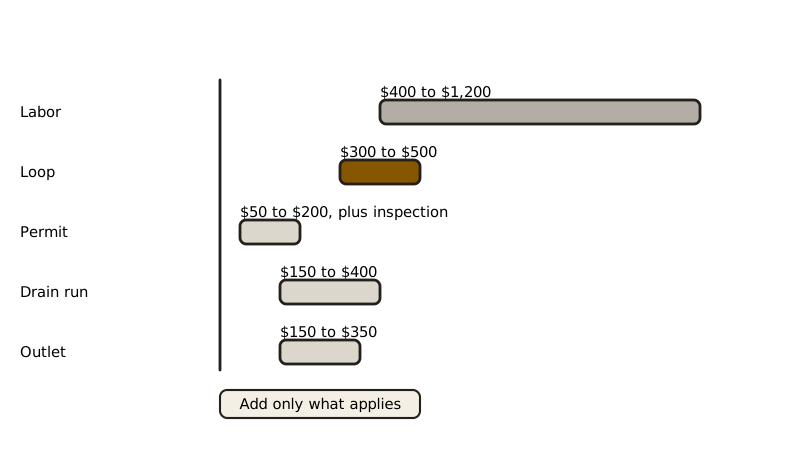
A quick calculator: labor low end plus the extras you need, then labor high end plus the same extras, and you have a window. That window only tests whether a bid is plausible.
What about brand names like Kinetico, Culligan and Rheem?
We have not verified any brand's price list, so we quote none. What can be said is how the business works: dealers of brand systems commonly bundle equipment and installation into one number, and the Kind Water guide says bundled in-home quotes reportedly run two to four times the hardware's market value. A plumber who installs a unit you buy elsewhere may price differently.
That goes for big-box offers too, including Costco and AquaSure-branded units: we could not confirm what any of them includes for installation, so ask exactly what is covered.
What does a loop installation cost, and do I need one?
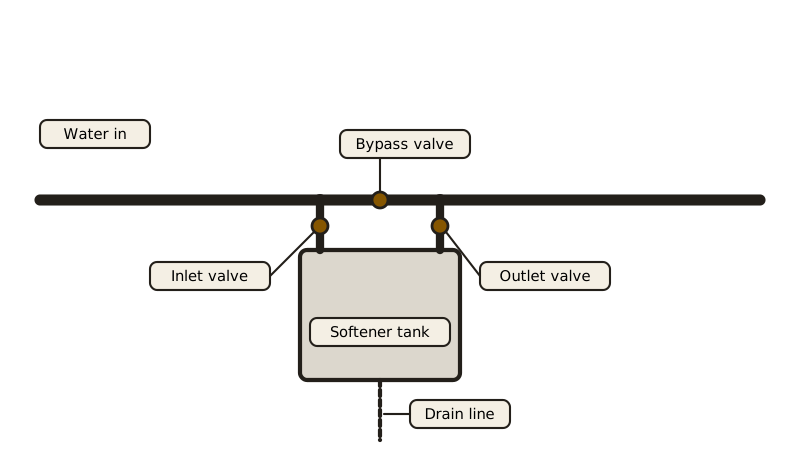
The loop is a pipe arrangement with valves, routing water into the softener, or past it when bypassed. If your house has one near where the softener will stand, the install is quick. If not, the Kind Water guide puts cutting one into the main at $300 to $500 extra. Without a bypass, any service on the unit means shutting the water off to the house.
Because it involves the supply line, the work is plumbing, with a permit where the city requires one. Rancho Cucamonga's Building and Safety office takes permit applications online. The guide above gives $50 to $200 for the permit.
Does the local water change what a softener costs?
Hardness sets how big a softener you need, not the labor. In CVWD's 2025 report total hardness spans 109 to 142 ppm, averaging 125.5, which converts to about 7.3 grains per gallon. CVWD's own FAQ calls its water moderately hard to hard, 81 to 190 mg per liter. Upland's 2024 city report shows 163 ppm on average, close to 9.6 grains.
Higher hardness means more frequent regeneration and, in a big household, a bigger unit. Sizing follows hardness and household headcount. Ask which supplier serves your address, since Upland has pockets served by other water companies; your bill will say. Also see the guide on how a softener is installed.
How do two softener bids get compared fairly?
Line the bids up row by row: the unit, labor, loop, drain, outlet, permit, removal of any old unit, and warranty terms. A bid with one lump figure cannot be judged until it is split. Differing scopes explain most price gaps.
Not one dollar figure here is a quote, and the actual price is set only when a plumber has seen the house and written it down. Start that through request a quote. What else we arrange is on the home page.
Common questions
Does the installer stay all day?
No sourced figure for hours exists. A swap onto an existing loop is the quick case; a new loop plus a drain run takes longer. The tap water goes off at some point. When booking, get the plumber's estimate of hours, and find out if the inspector needs a second visit.
What should the softener quote spell out?
It should say if the price takes in the loop, drain, outlet and permit, who supplies the unit, and what the warranty covers. A softener job with extras can cross the state's $1,000 line for needing a contractor, so verify the contractor's license through CSLB.
Is a softener worth it for the water here?
At 7 to 10 grains per gallon the water is hard enough that scale shows on fixtures and heaters, so many households consider one. Whether it is worth the cost depends on your taste for the extras, the salt and upkeep, and how much scale bothers you. That makes it a matter of comfort and upkeep rather than safety.
Is DIY realistic for a softener?
Many homeowners with plumbing skills do, and the guide above puts DIY at $150 to $450 all in. The trouble comes with cutting into the main, drain air gaps and permits. If your house lacks a loop, or the city requires a permit, bring in a plumber for that part.
Updated