Fitting a softener is a plumbing project with a few forgiving steps and a few unforgiving ones. Tapping the main supply, building a drain with a proper air gap, and leaving the bypass within reach make up the heart of it. If you know how to cut pipe and make a watertight joint, a weekend is realistic. If you do not, read on anyway, because knowing the steps lets you judge a plumber's quote. If you would rather pay someone, the softener installation by a plumber page covers that route.
Could you really fit a softener yourself?
For many homes, yes, with conditions. You need to be comfortable cutting and joining pipe, find a spot beside the main supply that has a drain and a socket, and accept that a mistake means a flooded garage. Anyone unsure about copper, PEX or soldering will do better paying a plumber for the connection alone.
The job splits into easy and hard halves. Placing the tank, loading the salt and programming the head are easy. Tying into the supply line, building the drain and sorting out the bypass are where leaks come from.
A hybrid works well. Many people set the unit in place and run the drain themselves, then have the plumber make the supply connections. That keeps the part that can flood the house in experienced hands.
Which parts of the job should a plumber handle?
Hand over the supply tie-in, any soldered copper, a new drain cut into the waste line, and permit work. Contractor licensing in California kicks in at $1,000 of labor and materials, or earlier whenever a permit is involved. A mistake behind a wall or slab is expensive, and insurance questions follow a DIY leak.
Whether a permit applies is for your city to say. Rancho Cucamonga's Building and Safety handles permits online only, and Upland runs a separate office of its own. Rules for appliances plumbed into the supply vary, so a quick call before buying is cheaper than a correction notice.
Gas lines, electrical rewiring, and main line changes are not DIY topics at all. A softener needs only a plug, so that is rarely an issue, but if no outlet exists, hire an electrician.
Older houses add a wrinkle. If yours still has galvanized steel supply lines, they can be corroded inside, and cutting into them may reveal a pipe that crumbles. That alone can justify a plumber, and the write-up on replacing galvanized pipe shows the process.
What should you check before you buy a softener?
Check five things: whether salt discharge is allowed on your property, how much space you have, your actual hardness figure, your household's daily water use, and whether your HOA or landlord must approve. Undersize it and it regenerates nonstop; oversize it and salt gets wasted.
Brine discharge rules vary by region, and the water district's FAQ does not address softeners at all. Its customer line, 855-654-2893, is the place to ask, and so is the building office for your city.
Sizing depends on grains of hardness times gallons used a day. A family of four with 7 to 10 grains of hardness has a different need than a couple living alone.
Rental and condo owners should ask permission before touching shared plumbing. For the money side, the softener installation cost guide helps you choose between DIY and a plumber. Other jobs we arrange appear on the home page, if you are curious.
In what order do the installation steps go?
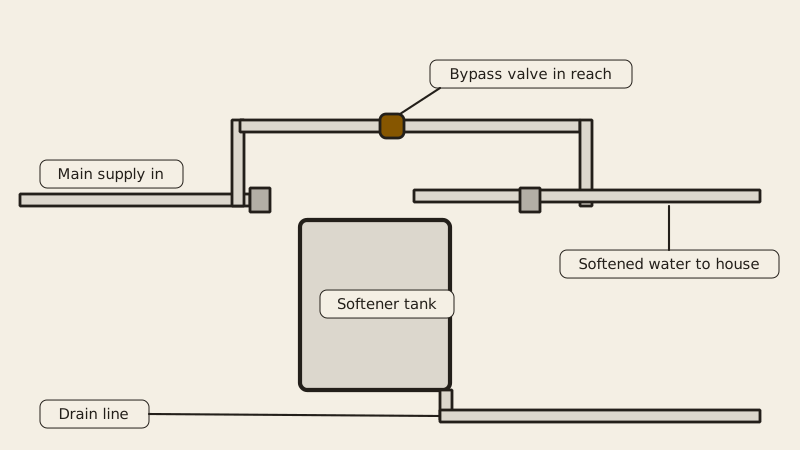
Plan on this order: choose the location, shut the main water off, fit the bypass with inlet and outlet pipes, route the drain with its air gap, add salt, run a regeneration cycle and test for leaks. Each step has a trap, and the list below names them.
- Pick the spot. Near the main line, on a level slab, with a floor drain or standpipe close by and an outlet within cord length.
- Isolate. Close the house valve, then let the pipes drain by opening taps on the top floor and the bottom.
- Cut in the connections. The tie-in goes just past the main and ahead of the heater, which means hot water is softened too. Many installers leave an outdoor hose bib on an unsoftened branch.
- Mount the bypass valve. It lets you isolate the softener for service without shutting the house down. Mount it where you can reach it with your hand.
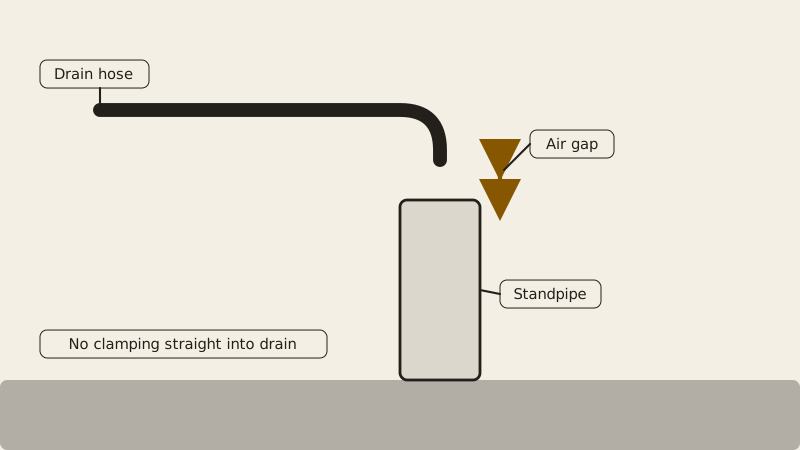
- Run the drain. Wastewater from regeneration must pass through an air gap, otherwise it can siphon back into the unit. Clamping the hose straight into a drain pipe is the shortcut that backfires.
- Load salt and set the hardness. Use the figure from the water report, then the head's programming guide.
- Open slowly and check. Open the main in small steps, bleed air from a faucet and watch every joint for ten minutes.
- Run a manual regeneration. Watch that the brine draws and the drain flows.
What is the hardness of the local water?
Moderately hard to hard. Cucamonga Valley Water District's 2025 report gives total hardness between 109 and 142 ppm, averaging 125.5, which is roughly 7.3 grains per gallon by the usual conversion. The district's own FAQ describes 81 to 190 mg/L. Upland's 2024 report shows 163 ppm detected, about 9.6 grains, for the city system.
Two separate sources, two separate ranges. They measure different years and different periods, so quote one or the other, not a blend. The USGS bands run soft to very hard, with breaks near 60, 120 and 180. A yearly 125 barely tips into hard.
Your own water bill names who serves you. Parts of Upland get water from a neighboring company, and the Etiwanda edge of Rancho Cucamonga may belong to another. Before sizing a softener, take the number from your supplier's current report, not from a neighbor's.
Can you clear scale off fixtures without buying a softener?
White vinegar does most of the work. Unscrew a showerhead or aerator, let it steep in a plastic bag of vinegar for about sixty minutes, then wipe and rinse. Kettles and glass respond too. Natural stone must be kept away from it.
The heater tank is a larger task. The water district's FAQ notes that heater thermostat settings and flushing practices matter and points to the manufacturer's guide. Flushing sediment once a year helps. Two related reads: swapping an anode rod and replacing a heating element, the parts scale hurts most.
Scale also narrows pipes over time, which the USGS links to lower pressure. If pressure has been dropping, see low water pressure causes before assuming it is the supplier.
Descaling treats the symptom. A softener treats the source, though it will not make water drinkable in any new way and adds sodium or potassium. Ask your doctor if you are on a restricted diet.
Common questions
Will it eat my whole Saturday?
A confident DIYer typically needs a day, with a second visit to check for slow leaks. A plumber working from a prepared spot needs less, but plan on a half day or more once connections, drain and testing are counted. Garage layouts and older pipe add time.
Does a softener call for a city permit?
The answer depends on your city and what exactly you change. In Rancho Cucamonga, permits are handled by Building and Safety, entirely online; Upland has its own office. California also requires a contractor license where a permit is needed. Call the building division with your plan before you buy, and let the plumber confirm.
Will a softener remove existing scale?
Slowly, in part. Softened water may loosen some scale over months, but heavy crust on elements, shower glass or inside pipes will not simply vanish. Plan on descaling fixtures by hand, and flush the water heater so loosened chunks do not collect at the bottom.
Is vinegar safe for descaling everything?
No. It is fine on chrome, glass and ceramic when rinsed, but it can dull or etch natural stone, damage some finishes and attack rubber seals if left soaking. Test on a hidden corner and follow the maker's care guide for the fixture.
Updated