Two published guides frame the numbers. One contractor's guide lists PEX at $3,500 up to $11,000 and copper at $5,000 up to $20,000, while HomeLight, quoting HomeAdvisor, climbs from $3,600 at 800 square feet to $13,500 at 3,000. Neither is local pricing; use them as markers only. Other jobs we handle appear on the homepage, and a visit begins at the quote form.
What does an old-house replumb come to in total?
Three pieces make up the total: the pipe material, the size and layout of the house, and the labor of opening and closing walls. HomeLight's HomeAdvisor averages by size run $4,500 at 1,000 square feet, $6,750 at 1,500, $10,350 at 2,300 and $13,500 at 3,000. Pipe itself is $0.40 to $2.00 a linear foot in PEX and $3 to $8 in copper, per HomeGuide.
Labor dominates, around three quarters of the total in the contractor's guide, which prices an hour of plumber time between $75 and $150; HomeLight gives $45 to $200. An old house costs more than a newer one of the same size, because pipes are harder to reach and walls are more fragile.
Why does an older house here cost more to replumb?
Age sets the starting point. In Upland's ZIP 91786 the Census counts 1,331 homes built before 1940 and 706 from the 1940s, and the typical house there dates to 1975. Cucamonga's ZIP 91730 has 446 pre-1940 homes and 1,232 from the 1950s. North Upland's ZIP 91784 has a median build year of 1982.
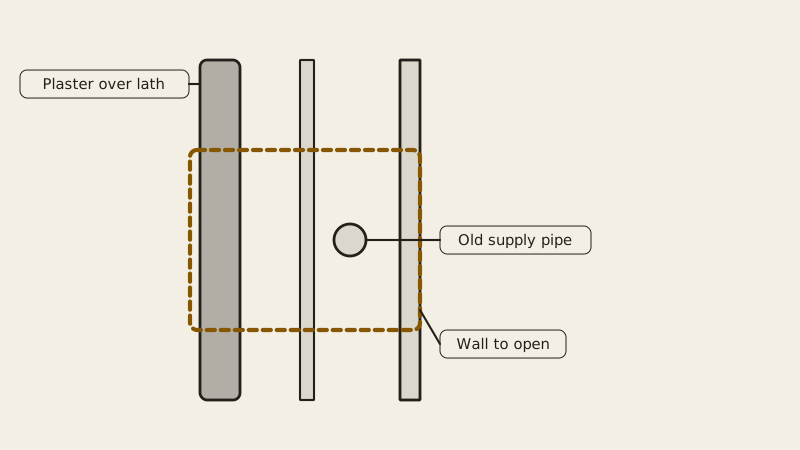
Houses from the earliest decades may have galvanized steel, early copper, plaster over lath, and no easy attic route. Tracts from the 1980s and 1990s were piped in copper or PEX and are simpler to work on. The difference shows up as extra hours cutting plaster and matching the original finish. The galvanized pipe replacement page covers the oldest case.
Which charges tend to be forgotten?
Wall repair tops the list. The contractor's guide says patching, texturing and painting can add $4,000 to $4,500 and often sit outside the first estimate. HomeLight confirms that opening walls to reach pipes carries its own fee, though it prints no dollar figure. Insist it appears on its own line.
Ask as well about permit fees, new shutoffs, a pressure regulator, water heater hookups and hauling away old pipe. HomeLight lists a sewer scope at $270 to $1,737 and a pressure test at $250 to $500, either of which may be sensible on a very old home before work starts. None is automatic, so find out which are included.
Must everything go, or just a section?
Not necessarily. Supply pipes, drain lines and the gas line are three separate systems. A house may have sound drains and failing supply lines, or the reverse. Mending only the worst run costs far less than starting over, and scoping the drains with a camera and pressure-testing the supply side show where the real trouble is.
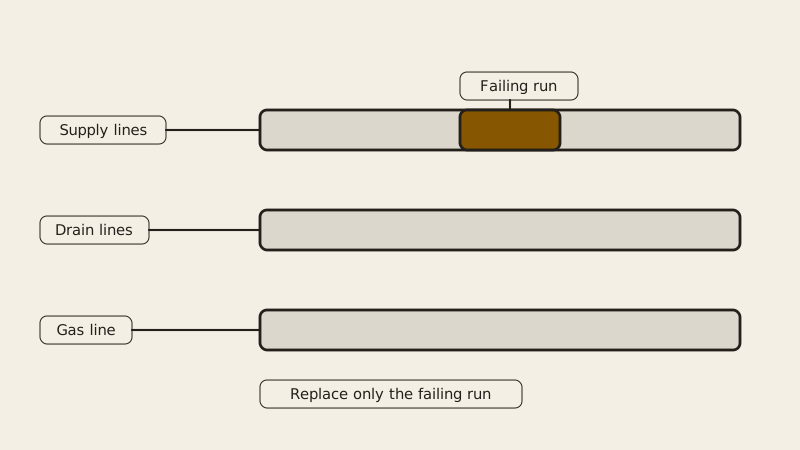
Go for everything when the material itself is the issue: galvanized rotting from inside, or pinholes repeating across rooms. If a single bathroom is affected, treat that as a project of its own. How a whole-house job unfolds is explained on the repipe service page, with the line items on repiping costs.
How does the pipe you pick change the price?
PEX is lower in price and quicker to fit; one guide gives it four to five decades of life and copper five to seven. Copper costs more mainly because every joint has to be soldered. PEX versus copper compares them, and the contractor's guide adds that copper often has no manufacturer warranty while PEX frequently carries a 10 or 25 year one.
Whichever you pick, have the quote name the material and fittings. Ask too whether a shutoff at every fixture is included, because adding them now costs little and saves effort later. Drain pipes inside the house are priced apart from supply lines and are not part of the numbers above.
What does California require, and what about gas piping?
The state board, CSLB, explains that California limits two kinds of work to contractor-license holders. One is any job that reaches $1,000 in total cost, labor included. The other is any work that calls for a permit. A whole-house replacement clears the first easily. Paper contracts begin at $500. Deposits usually cannot exceed ten percent of the contract or a flat $1,000, with the smaller figure winning; the board can confirm today's rule.
Gas piping is its own safety matter: only a contractor should touch it, and with a permit. Should you smell gas, exit first. The gas company, SoCalGas, takes emergency calls at 1-800-427-2200; place the call after you are outside, and use 911 for immediate danger. On permits, Rancho Cucamonga addresses deal with that city's Building and Safety division, while Upland addresses use Upland's Building and Safety Division.
How should you choose among bids?
Line up at least two bids on paper. Each ought to state the pipe material, which rooms and fixtures are covered, where walls get opened and who closes them, the permit, the deposit, the timeline and the days without water. Confirm the license through CSLB's website before signing. A bid far under the rest nearly always omits something.
Timing shapes the decision too. Plans matter too: a house on the market soon may need only the failing section, whereas one you will keep for decades is the stronger candidate for the full job. Afterward ask about upkeep, meaning a pressure check, a test of each shutoff valve and a check of how the water heater is connected.
Common questions
How disruptive are the days it takes?
One published guide says most whole-house repiping takes three to seven days, longer for big or complicated homes. Plaster walls, upper floors and slabs add time. Request a schedule that shows the dry-tap days and the date walls are patched.
Can you live there while it happens?
Often yes with PEX, accepting some dust, noise and hours without water. Lengthy copper jobs push some families to stay elsewhere, according to repiping guides. Ask for one bathroom to stay usable and for notice before each shutoff, so you can fill containers and plan around it.
Does it pay off before selling?
That hinges on what is wrong. Active leaks or galvanized lines may worry buyers or inspectors, while sound copper rarely needs work. Obtain an inspection report first and decide if a narrow repair will do. In every case, the number on a quote you hold is the true cost.
Is it smart to swap the water heater too?
A tank close to retirement is worth swapping while the pipework is open, since hookups go in easily and you avoid paying twice for access. Price the heater as its own line. What that job normally covers is explained in water heater replacement costs.
What is the first move?
Start with an inspection that names the pipe material and measures pressure. Next, gather written bids that spell out material, wall repair and permit. To have us book a local plumber for that inspection, send the request form; the figures above give you something to compare against.
Sources used
- HomeLight, cost to replumb a house, citing HomeAdvisor and HomeGuide figures (read November 2026)
- Repiping cost and timeline breakdown, PEX versus copper (price guide read November 2026)
- US Census Bureau housing data for ZIP 91786, 91730 and 91784 via Census Reporter
- California Contractors State License Board
Updated