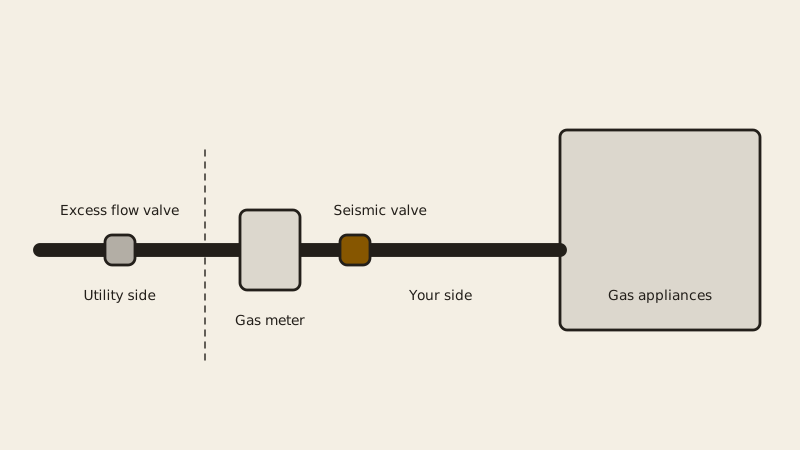
Imagine a strong jolt at 3 a.m. while everyone sleeps. If a gas connector has pulled loose behind the dryer, fuel starts filling the house, and nobody is awake to close anything. A seismic valve exists for exactly that gap. It is a mechanical shutoff on the house's gas line that closes itself when the shaking passes a set level.
Whether a house needs one is decided locally, not statewide. Below: what the valve does, which types exist, how it is reset, price, and the first move after a shake. Broader piping questions are covered under gas line services.
What happens inside the valve when the ground shakes?
Inside the body, a ball or float settles over the gas port and seals it. A federal lab's guide says this occurs for ground movement equal to an earthquake of about magnitude 5.4 or more. No power is needed. It cannot judge whether any pipe is broken; it only responds to the shaking.
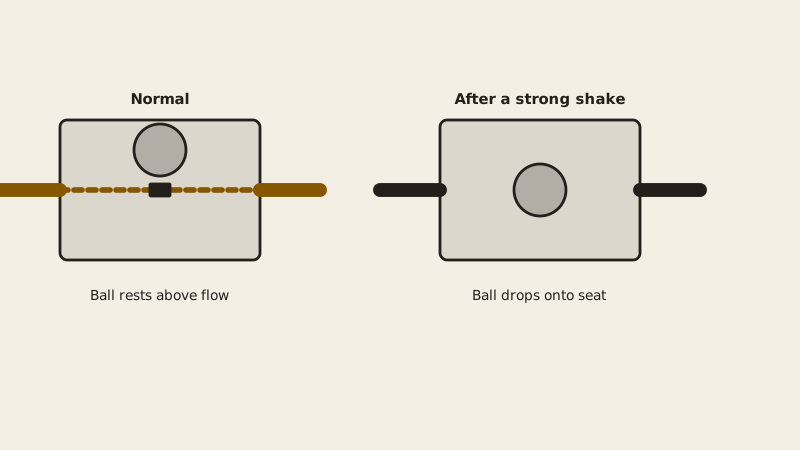
Light tremors leave it alone, which is intended. Its purpose is to act after the sort of shaking that cracks joints and moves appliances, even when nobody is home to reach the meter.
Where is it mounted, and what is the utility's valve?
The seismic valve is fitted just after the meter, which puts it on the homeowner's side. A separate part, the excess flow valve, sits upstream on the utility's side and trips when a line ruptures rather than when the earth moves. The federal guide says excess flow valves have been required on new gas-served homes since 2006.
SoCalGas lists Rancho Cucamonga, Cucamonga, Etiwanda, Alta Loma and Upland among its communities, and it puts owners in charge of the pipe from meter to appliances. Meters differ: some stand beside the wall, some sit in a curb box, some hide behind shrubs, and each layout changes the work.
Automatic, actuated, best: are these different valves?
No, they are the same family under different names. Automatic means nobody has to act. Earthquake-actuated names the trigger. For California, the federal guide says the valve should be approved under the State Architect's Standard 12-23-1, and it cites ASCE 25 and ANSI Z21.70 as the national seismic-valve standards.
Which is best? An approved model fitted properly beats a fancier one fitted badly. Put three questions to the installer: which approved model, whether it fits your meter's pipe size, and what the manufacturer says about resetting. Nobody honest can crown a winner without seeing the meter.
How much does a seismic gas valve run?
The same federal guide gives $100 to $1,000 for seismic valves in its summary table, without saying how much of that is labor. Treat it as a wide guide. Meter position, pipe size, any change to the line and a permit, where one applies, will all shift the total.
A cramped or buried meter box raises labor more than the part itself does. The gas line cost page covers gas jobs generally. Your house gets its own figure only when a plumber has seen the meter and put a price on paper.
What does resetting a tripped valve involve?
A person has to do it, and only after the house is confirmed leak-free. The federal guide says the valve stays closed until reset by hand once a safety inspection shows no leaks inside. Some jurisdictions let owners reset their own valve; others do not. Keep the manufacturer's sheet that came with the valve.
SoCalGas takes a firmer line on the meter itself. If gas has been shut off there, keep it closed and phone for a utility visit, since pipes and appliances need inspecting first and only utility staff reopen the meter. After a major quake, restoration may take a while.
How can I tell my house is missing a valve?
If nobody can show you one, assume there is none. Check the meter, plus the pipe beyond it, or ask whoever did the last gas work. A house running a furnace, dryer and tank heater on gas has more to leak. A contractor can look over the meter and everything on your side of it.
After shaking, use your nose and ears. Gas smell or hissing, or a visible break: get everyone out. No smoking, no flames, no light switches, the utility warns; go outside and use the utility's emergency line, 1-800-427-2200; 911 covers a failed connection. Its home safety guide adds that you should not shut off the meter unless you smell gas.
Does Rancho Cucamonga or Upland require one?
The federal guide says rules vary by local building code. We could not verify a Rancho Cucamonga or Upland requirement, so do not take it for granted on a sale or remodel. The cities' Building and Safety offices can answer for a specific project; Rancho Cucamonga's takes permit applications online.
California ties contractor licensing to the size of a job, $1,000 counting parts, and to any permit-required work, and meter-side gas piping falls under that. Look for a line saying whether a permit is covered and who arranges the inspector.
What about the Northridge earthquake?
Searches for these valves often mention Northridge. We have not checked how that event shaped present rules, so we leave that out. From the sources above, the message is plain: an approved valve, fitted by a contractor, is the sensible choice for a home that burns gas.
To get the meter looked at and priced, send the details through request a quote, or browse other jobs we arrange from the home page. Questions people send us follow.
Common questions
Is the gas off for long during the install?
Short, when the meter is easy to reach: the valve threads onto the pipe, the gas comes back, and the plumber checks for leaks and relights pilots. A buried meter box or a pipe change stretches the visit. If a permit applies, an inspector comes afterward, so ask for a time estimate before booking.
What should the contractor be able to show me?
A California license number that checks out on the CSLB site, the valve's model name with proof it meets the State Architect's standard, and a clear note on what the quote covers, permit included or not. Ask for the reset instructions on paper too, because you may need them at an awkward hour.
Must somebody stay home for this?
Ideally, throughout. The meter has to be reached, and the plumber may need indoor access to relight pilots and inspect appliances once gas returns. Having someone present also means any surprise gets decided on the spot, and you see the valve demonstrated before the visit ends.
Could the valve close when there has been no quake?
It is built to react to ground motion, so on ordinary days it stays open. A break on the utility side is the excess flow valve's job instead. If your gas dies with no shaking at all, count it as a service fault and ring the gas utility instead of resetting things yourself.
Updated