
Zinc-coated steel looks sturdy, but the zinc wears away, the steel rusts, and scale slowly narrows the bore until a shower dribbles. The cure is new copper or PEX in place of the old lines, usually as a whole-house repipe. The sections ahead cover spotting it, the work itself, the calendar and the permit.
How do I spot galvanized supply lines at home?
Inspect whatever supply pipe is visible: by the water heater, under a sink, in the garage, near the meter. Dull gray, screwed together at the couplings, and attracts a magnet: that is galvanized. Copper has a warm brown-orange tone, while PEX is flexible plastic tubing in bright colors. A key scraped over an out-of-sight spot exposes silver-gray steel if the pipe is galvanized.
Symptoms often show up before you see the pipe:
- Brown or rusty water when the tap has been idle, especially hot water.
- Pressure that is weak at every fixture and keeps getting worse.
- Weeping at threaded couplings.
- Flaking rust on visible fittings, or green and white crust at the transition to copper.
Age is a clue. Census figures show that ZIP 91786 in Upland has 1,331 homes built before 1940 and 706 from the 1940s, and ZIP 91730 in Cucamonga has 446 built before 1940 and 1,232 from the 1950s. Older streets like these are the likeliest places for leftover galvanized, unless an earlier owner already swapped it. Homes in the planned communities built from the 1960s onward are more likely to have copper, though only a look at the pipe settles it. Check low water pressure if your main complaint is flow.
Is there still a polybutylene pipe replacement program?
No. The class action settlements that once paid to replace polybutylene plumbing have closed. The last Cox v. Shell claims window shut on May 1, 2009, and sources we checked found no open fund or claim form today. If your house has polybutylene, you pay for replacement, and insurance may help with leak damage but often not with the pipes. Be skeptical if someone offers to file a claim on your behalf.
Polybutylene went into houses from roughly 1978 to the mid-1990s, so homes of that vintage here could still have it. It is usually gray, sometimes black, flexible plastic, often joined with gray or white plastic fittings and metal crimp rings. Try beside the heater, up in the attic and wherever the supply first comes indoors. Replacement is the same kind of project as for galvanized: new lines in PEX or copper, with the old pipes abandoned or removed. See PEX vs copper for how to choose.
What does replacing galvanized pipe actually involve?
The plumber traces the existing lines, closes the water, runs new copper or PEX out to every fixture, hooks up the heater, tests the whole system under pressure, and then closes the openings. Some of the old pipe may be pulled out and some abandoned in the wall. Wall and ceiling access determines most of the effort, and drywall patching is often a separate trade.
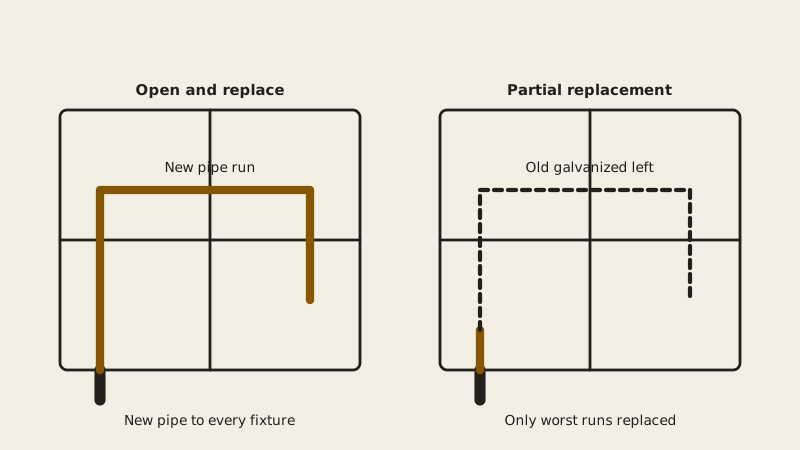
Two common approaches:
- Open and replace. Holes are cut in drywall at strategic spots so new lines can be fished through, then patched. This is the usual route for single-story homes with attic or crawlspace access.
- Partial replacement. Only the worst runs are replaced, such as the main line or kitchen. It can spread cost but leaves old galvanized elsewhere, with joints between metals to watch.
For the order of work, see repiping step by step. On money, the factors behind a repipe quote are explained in repipe pricing for Rancho Cucamonga and plumbing replacement in an older house: the number of fixtures, wall type, access, the material you choose and permit fees. We print no dollar figures here, because none we found were specific to this area. No price exists for your project until a local plumber has seen the house and written a quote.
What is the usual duration of a house repipe?
A small home can often be done in a few days and a larger or two-story house may take longer, since the schedule depends on the number of fixtures, wall access and how much patching is included. Expect gaps with no running water on work days. Get the schedule in writing, including whether drywall and paint are part of it.
What lengthens the job:
- Plaster walls or finishes that must be matched.
- Multiple bathrooms and a second story.
- A slab-on-grade house, where lines under the floor get rerouted overhead or through walls.
- Hidden problems found when walls open, such as old fittings or damaged framing.
- Waiting on inspection.
Plan for the household to live without running water for stretches, and for dust and noise. Some households book a night or two elsewhere. Pull furniture and stored boxes back from walls likely to be opened.
Does repiping require a permit in Rancho Cucamonga or Upland?
Normally yes. Replacing the water supply piping of a whole house is generally treated as permitted plumbing work, and the city's building division inspects it. In Rancho Cucamonga that is Building and Safety, which handles applications online and does not issue permits over the counter. Upland routes applications through its own online portal. Settle early who files the permit application and whether the fee is already counted in the quote.
Why it matters: going without one can cause headaches at resale or at claim time, and an inspection gives the job an independent check. California ties the contractor license rule to permitted work and to $1,000 jobs. Holders can be searched at the state board's website, cslb.ca.gov. Gas piping is strictly contractor work, and swapping a water heater needs its own permit.
For specifics on a given address, call the building division: Rancho Cucamonga, (909) 488-4668 for permitting questions; Upland, (909) 931-4110.
Should I replace now or wait?
Replace sooner if you already see rust in the water, falling pressure, or leaks at threaded joints. Waiting makes sense only if the lines are in good condition and you are planning a larger remodel soon, since opening walls once saves effort. Pipes that fail suddenly can mean emergency work and water damage, so a planned repipe is usually calmer and cheaper than an emergency one.
Practical ways to decide: ask a plumber to test pressure at several fixtures, to cut and inspect a section of pipe, and to note the age and material. A section cut from the line shows how much of the interior has closed up. Leaning toward waiting? Read the meter with every tap closed. A turning dial hints at a hidden leak, which is reason enough to move. Houses on slabs raise special issues, discussed under slab leak or repipe.
Common questions
How long does galvanized pipe replacement take?
For most houses, a matter of days rather than weeks, with drywall and paint extra. Timing hinges on wall access, bathroom count and the foundation type, slab or crawlspace. Get the schedule written, with water-off windows, so meals, showers and laundry fit around it.
What should the quote for a repipe include?
Look for the permit, the pipe material (PEX or copper) with the reason for it, the wall patching plan, and whether old galvanized comes out or stays abandoned in the wall. At $1,000 and above, the contractor license rule applies, and cslb.ca.gov has the lookup. Insist that it describes the scope.
Should I be home during the pipe replacement?
Yes, you or a trusted person, since every room needs to be reachable and water shuts off periodically. You need not watch each step. Plan for dust and noise, and move furniture from the walls. In a rental, the owner generally arranges it, so talk to the landlord first.
Can I keep galvanized pipe if it still works?
You can, as long as flow is fine and nothing leaks, though the decline tends to be silent, with corrosion piling up out of sight inside the steel. Brown water, a pressure slide or a leak are the cues for a plumber's test. Replacing it before it fails is usually easier than doing so in an emergency.
Is polybutylene the same problem as galvanized?
Different material, same outcome: both are old supply pipes that homeowners usually replace. Galvanized rusts inside and starves flow. Polybutylene is plastic piping from the 1978 to mid-1990s era, with a reputation for leaks at fittings. Neither is a quick fix, and replacement follows the same permit-and-patch process.
This guide is one of many on Cucamonga Peak Plumbing.
Updated