Picture the house with its water lines pulled out and replaced end to end. That is a repipe. Day one starts with a shutoff and ends with a pressure gauge holding steady on new tubing; the city inspector and a drywall patcher come after. Nobody does this casually on a Saturday. It needs a permit, and California puts a job this large in a contractor's hands.
Still unsure the house needs it at all? The overview of repiping and pipe replacement covers the warning signs. What follows is the how.
How do I repipe my house, in order?
Six stages, usually. Protect floors and kill the water. Open small windows in the drywall at each fixture. Thread the new main and branch lines through them. Fit a valve at every fixture. Pressurize the whole system and watch for drops. Then the inspector looks, and only afterward do the holes get closed and painted.
Expect the faucets to be dry for most of the first working day. Households often plan to eat out, shower at a gym or stay with family, and the schedule should say when water returns, not just when the work ends.
What should be decided before a single hole is cut?
Four items: what the new pipe is made of, who files the permit, where the access openings go, and who restores the walls. A phone description is not enough to price any of them. Open drywall is also the cheapest time to add a pressure regulator or relocate a shutoff, so raise both now.
Age points to the likely problem. Census Reporter lists 1975 as the median build year for Upland's 91786 ZIP, and 2002 for Etiwanda's 91739; Alta Loma's 91737 has 3,992 of 8,340 homes from the 1980s. Older tracts may have pitted copper or clogged galvanized steel, while a 2002 house usually does not need this at all. Look at the pipe before assuming.
PEX or copper: which one goes into the walls?
PEX is a plastic tube that curves through a framing cavity, so a run needs fewer fittings and smaller access cuts, which usually trims labor hours. Copper is stiff, and each elbow is a soldered joint. California has permitted PEX for drinking water since the 2010 re-approval reported by Contractor magazine, residences included. The comparison page, PEX versus copper, goes deeper.
PEX comes with conditions. Buried runs need a sleeve against solvents and petroleum products. California also demands a minimum of 30 days of UV resistance from any PEX installed, so coils should not sit in sunlight. Copper counts decades of use in its favor, and neither pipe dodges scale: CVWD measured 109 to 142 ppm hardness in 2025.
What changes when the floor is a slab?
With supply lines buried in the foundation, the cheaper route leaves the concrete alone. Buried pipes get capped, and replacement lines drop from the attic into the wall cavities. You swap a bigger drywall patch for an unbroken slab. The floor plan and the location of the trouble decide whether that is workable.
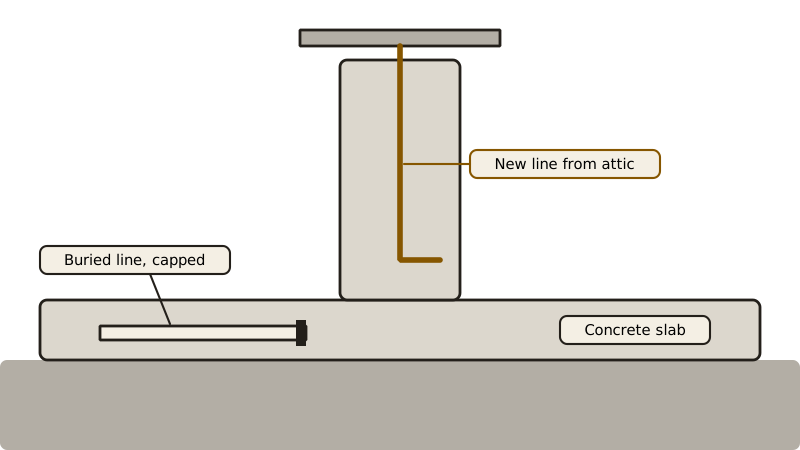
If a single buried line is the culprit, skip the whole-house job for now; slab leak repair or repipe compares the two. Insist that the route be described before the scope is agreed.
What does the new plumbing look like inside the walls?
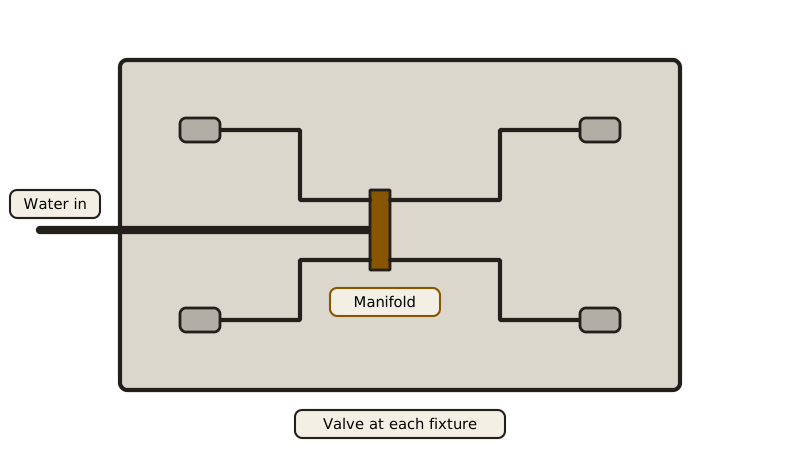
A PEX job is often laid out as a manifold with one dedicated line to each fixture, or as a trunk with branches. Lines are strapped at intervals and kept clear of sharp edges. A copper job is cut, fitted and soldered one section at a time, with straps along the run.
Old lines are frequently not extracted. Pulling them out of closed walls means more demolition, so dead pipe may stay capped inside the cavity. Ask what will be left behind, and write the answer into the scope.
Can a homeowner repipe the house alone?
Not the main work. State law hands anything priced from $1,000 up, or anything needing a permit, to a contractor with a CSLB license, and a repipe trips both triggers. The homeowner's part is clearing access, moving furniture and choosing the finish on patched walls.
Rancho Cucamonga Building and Safety takes permit applications online only, with no over-the-counter issuing. Upland runs a division of its own, with counter hours Monday to Thursday; the office is closed Fridays. The contractor you hire should say who files the permit paperwork and who meets the inspector.
What are the first steps to take now?
Photograph whatever pipe is visible, in the cabinet under a sink or beside the heater, and jot down symptoms: weak pressure, brown water, damp patches. Then ask for quotes that name the tubing, count the fixtures and say who handles permit and drywall.
For price context see what a repipe costs and costs for an old house. Ready to start? Describe the house through request a quote. The home page shows what else we arrange for homeowners.
Common questions
How many hours is the house without water?
Most of the first working day, as a rule. Total duration swings with size: a one-story house with one bath moves faster than a two-story with three. Plumbing work, inspection and wall repair are separate steps with gaps between them. Get a written timeline that gives the inspection date and says when taps come back on.
Is PEX permitted for homes here?
Yes. The state plumbing code approves PEX for drinking-water lines in residences, which covers Rancho Cucamonga and Upland alike. Each city still requires a permit and an inspection. Before issuing the permit, the building official requires the contractor to certify that code flushing and tagging rules will be followed.
Will the repipe need a permit and inspection?
It will. Replacing the supply system is permit work. Rancho Cucamonga applications go online through Building and Safety, and Upland uses its Citizen Self Service portal. Normally the contractor files and books the inspection; get that written into the contract before anyone starts cutting.
What if only one pipe is leaking?
Then a repair on that pipe may be all you need. One pinhole, one weak fixture or one worn valve does not justify tearing into every wall. Repiping starts to make sense when leaks keep coming back, the pipe shows corrosion in several places, or pressure is poor at every tap. Start with low water pressure.
Updated