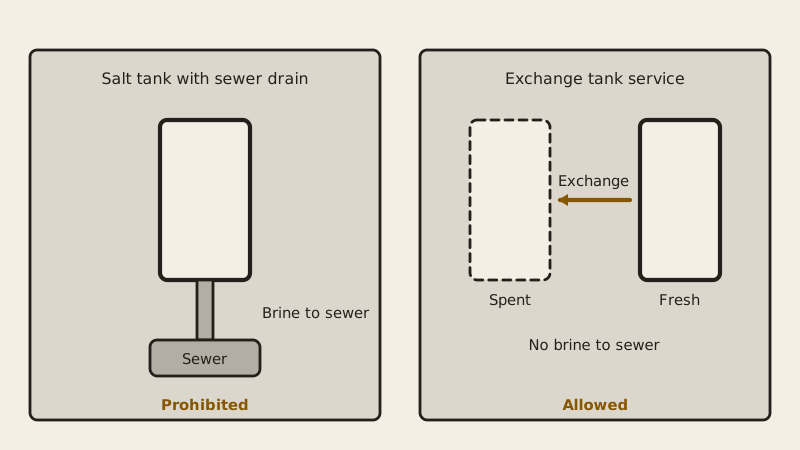
In Rancho Cucamonga, the water district's published rule is that softeners with a salt tank and a sewer drain, which dump brine into the sewer when they regenerate, are prohibited. Softeners serviced by a vendor who swaps spent tanks for fresh ones are acceptable. That makes the first question which kind you may legally install. When you have decided, the quote form is where a local plumber to fit it gets arranged.
Why is hard water such a problem in Rancho Cucamonga and Upland?
Hardness is calcium and magnesium carried in the water; these crust up faucets, coat water heater elements and slowly line the inside of pipes. Cucamonga Valley Water District reported total hardness between 109 and 142 ppm in 2025, averaging 125.5, roughly 7.3 grains per gallon by our own arithmetic (one grain is 17.1 ppm).
The district's own FAQ describes its water as moderately hard to hard, 81 to 190 milligrams per liter. Upland's city system averaged 163.42 ppm in its 2024 report, near 9.6 grains per gallon, and its readings ranged as high as 340. Some Upland and Etiwanda-edge addresses are served by other suppliers, so read your own water bill to see whose figures apply to you.
What is prohibited, and what can you install?
The district states that softeners which discharge salt or brine to the sewer during a self-regenerating cycle are prohibited, and that systems with a salt tank reservoir and sewer drain fall in that group, so check the district's current rule before you buy one.
What the district calls acceptable is a softener serviced by a vendor who exchanges spent bottles for fresh ones. The Inland Empire Utilities Agency FAQ adds that some vendors offer non-salt treatment units. Confirm with the district's Engineering and Planning line at 909-987-2591 before you buy, and in Upland ask Public Works at (909) 291-2930, since this page has only read the Cucamonga Valley rule.
Can you get paid to remove an old salt softener?
Possibly. Inland Empire Utilities Agency offers a rebate for removing a self-regenerating softener, quoted on its FAQ as 100 percent of the reasonable value, between $300 and $2,000, plus free removal and disposal. Without a proof of purchase, a $300 rebate is available if the softener is connected and working.
IEUA says rebate programs run on a July 1 to June 30 fiscal year, funding is limited and first come, first served, and a unit must be connected and working to qualify. The agency's contact is 909-993-1550 or softenerrebate@ieua.org. Check the details before you pull the unit out, and ask the agency whether approval must come before removal.
What does the install itself involve?
The plumber sets the unit near where water enters the house, installs a bypass valve, connects the inlet and outlet, and, where the system has one, runs a drain and brine connection and programs the control head. If the house has no softener loop already, a loop with new valves and fittings must be added at the main line.
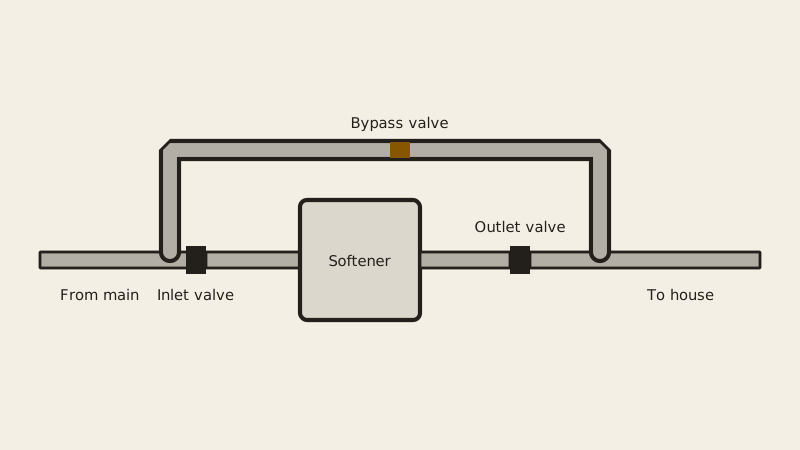
Placement shapes the job. A garage wall beside the main shutoff is easy; an outdoor pad, a distant water entry or cramped access means extra plumbing. A nearby outlet is needed for electric controls. Many newer systems need very little more than that, which is why the exchange-tank style keeps installation lighter.
What should the installation budget be?
Fixr prices an installed ion exchange softener from $650 to $3,000, labor alone from $150 to $1,000, with $600 up to $2,000 more to build a loop if none exists. An installer's guide puts labor near $300 to $600 for the bypass, drain and brine connections, and a complete salt-based whole-house system at $800 to $3,000.
Capacity, tank count and the distance from the water inlet all move the price. Permit fees and any electrical work are usually separate. These are national guides and the exchange-service model prices differently from a purchased unit, so only the figure in writing on a quote you hold is the real price.
Do brand names change the install? Culligan, Kinetico, Whirlpool and others
The plumbing connections are very similar across makes: inlet, outlet, bypass, and a drain where the model has one. What differs is the manufacturer's instruction sheet, the warranty terms and, sometimes, a requirement to use their authorized installer, which one cost guide flags as a price factor.
Read the manual for your exact unit and pass the model number along. Offers that include free installation are worth reading closely: check whether the offer covers the loop, the drain connection and any permit. Ask also whether the model is a prohibited self-regenerating one in your service area before it is delivered.
Is installing one yourself a good idea?
Plenty of people try. The risks are a leak behind a finished wall, a drain tied in without an air gap, and buying a unit your district prohibits. Cutting into supply piping brings California's contractor rules into play. The state board, CSLB, treats anything of $1,000 or more, materials and labor together, as contractor-only work, and the same goes for work that needs a permit.
A softener alone may fall under it, while a loop cut into the main often goes past it. Ask the permit counter in Rancho Cucamonga (Building and Safety) or in Upland. Someone who knows the local rule can save you from a unit you cannot legally run.
Common questions
Does a softener lower a water bill?
Not directly; it changes scale, not the volume you use, and scale wears out a water heater sooner and drags down its efficiency. If a bill jumped, the high water bill checklist lists what to check first. The IEUA FAQ says removing a softener can save up to 5,000 gallons a year.
Does hard water damage plumbing?
Mineral scale narrows pipes and coats heating elements as years pass, so pressure and hot water output can slip. Water heaters feel it most, since scale insulates the element from the water it is meant to heat. For tank water heaters, a flush now and then helps. The water heater repair guide covers scale buildup inside tanks.
Is a salt-free conditioner a legal option here?
The district's page prohibits salt-tank softeners with a sewer drain and calls vendor-exchanged tanks acceptable. The IEUA FAQ says you can switch to a non-salt treatment unit and notes that it does not endorse any particular unit or vouch for how well one works. Ask your water supplier before you buy anything.
What is a sensible total?
Plan on the low thousands of dollars for a whole-house system installed, according to the guides, with lower and higher cases on either side. See water softener installation costs and the how-to guide for the breakdown. Hardness, household size and access all move the number.
What should I have ready?
The unit's model number, a photo of where water enters the house, the location of the nearest outlet, and your supplier's name from your water bill. Tell the plumber if you have hard-water scale on fixtures. More of what we organize is on the Cucamonga Peak Plumbing home page.
More in this guide
- Water softeners
How a water softener goes in, which steps a handy homeowner can do, which need a plumber, and how to clear hard water scale in Rancho…
- Costs
What water softener installation labor costs, what adds to it, and how to size one for Rancho Cucamonga and Upland hard water.
Sources used
- Cucamonga Valley Water District, Water Softeners
- Inland Empire Utilities Agency, Save Water FAQ and softener removal rebate
- Cucamonga Valley Water District, 2025 Water Quality Report
- Cucamonga Valley Water District, customer FAQ
- City of Upland, 2024 Consumer Confidence Report
- Fixr, water softener installation cost (price guide read November 2026)
- Alert Plumber, water softener installation cost guide (read November 2026)
Updated