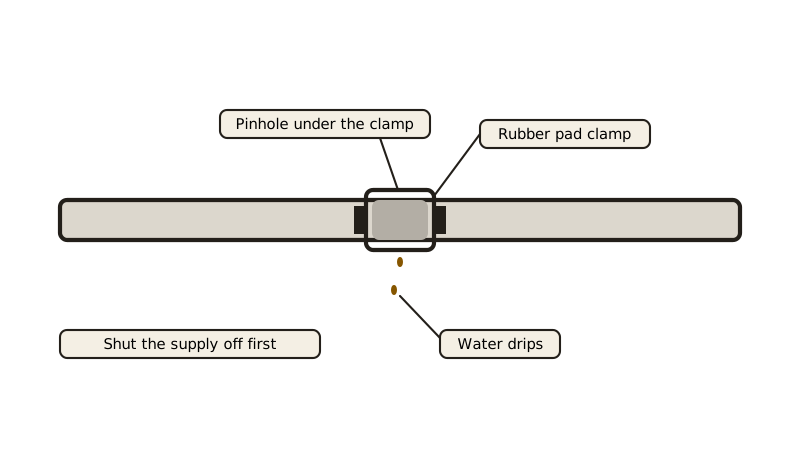
Corrosion can eat a hole no bigger than a pin through copper, and the resulting fine spray soaks drywall long before anyone notices. The fast version: turn off the supply, dry the copper and fasten a clamp across the hole. That gains time until a plumber replaces the damaged length. Other kinds of hidden water are sorted out in the leak section.
Is there a way to stop a pinhole leak without a plumber?
Yes, often. Turn the supply off, run the bathtub or hose bib nearest the floor until the line is empty, and dry the copper with a rag. A rubber-backed clamp or turns of self-fusing silicone tape hold many pinholes within minutes, and a small one may take drinking-water-rated epoxy putty. None is permanent, because the copper near the hole has likely thinned.
The stopgap options, in rough order of reliability:
- Clamp with a rubber pad. Line the pad up over the hole, then tighten both bolts evenly. It is the most dependable quick fix on a straight run.
- Self-fusing silicone tape. Stretch and wrap it in overlapping turns over a clean, dry pipe, so it bonds to itself.
- Two-part epoxy putty. Kneaded and pressed over a dry hole, it cures hard. Check the label for use on potable water lines.
- Rubber patch with hose clamps. A last resort when nothing else is on hand.
None of these should be left for long. Water pressure keeps working on the weak spot, and the leak may reappear in a day or a month.
What is the permanent repair for a pinhole in copper?
Take out the damaged length and fit new copper in its place. Once the line is shut and drained, fresh copper replaces the damaged length, connected with either soldered fittings or flame-free push-fit couplings. Sweat soldering takes a bone-dry pipe, plus flux, solder that is lead-free and a torch. Wood framing close by turns that flame into a genuine fire hazard.
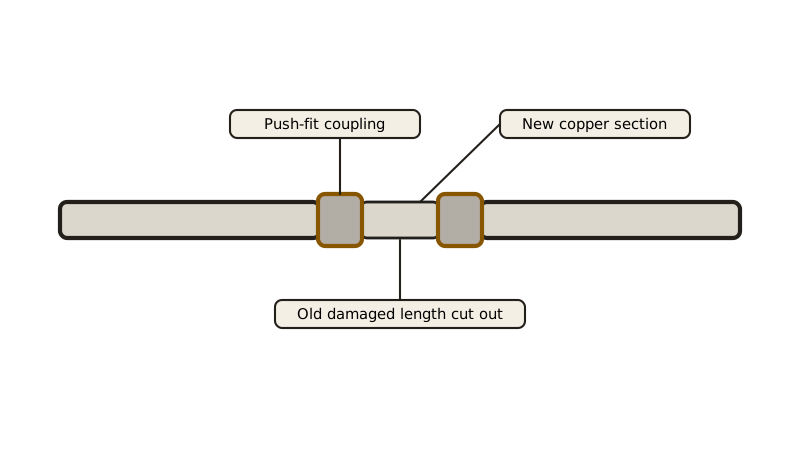
For most homeowners, a push-fit coupling is the realistic DIY route if you are comfortable cutting pipe cleanly and deburring the ends. Near gas lines, behind finished walls or on the main supply, a plumber should do the work. Replacement may need a permit if it grows beyond a simple repair, so ask Rancho Cucamonga's Building and Safety division, which takes permit questions online. If the leak recurs, ask about repiping the house, and compare PEX vs copper first.
Soldering skills matter. A poorly sweated joint leaks, and heating a wet pipe never works, because the water keeps the copper from reaching soldering temperature. That is the usual reason first attempts fail.
Why does copper pipe get pinhole leaks, and will there be more?
Pinholes come from corrosion that eats from inside or outside the pipe, and the cause is often water chemistry, flow speed, or dissimilar metals touching. One comparison notes that pinhole leaks can develop over time in aggressive water, and copper is moderately resistant to corrosion. A first pinhole often means other sections are thinning too, so watch for more.
What can contribute locally: Cucamonga Valley Water District's 2025 report shows total hardness from 109 to 142 ppm, which tends to cause scale rather than a particular corrosion pattern, so we cannot say water alone explains your leak. A plumber can look at where and how the pipe failed. If you see several pinholes, green crust or stains along a run, replacement of that run, or a repipe, is worth pricing in a written quote. See what a repipe costs in Rancho Cucamonga for the factors.
What tells me a pipe has cracked behind drywall?
Silence the house first, then listen for hissing or trickling. Look for stains, blistered paint, warped baseboards, a musty odor or a warm, damp patch. The meter is the referee: write the number down, leave the house water-free for two hours and compare. EPA reads any change as water escaping.
Dial moving but nothing visible? Close the main. If it freezes, the leak is somewhere on your property side. Hidden leaks are found with leak detection gear, letting a plumber pinpoint the spot before cutting any wall. More clues sit in the checklist for confirming a burst, while the opening hour of a flood is handled in the burst pipe emergency page.
EPA's figure for an average leaking household: 9,300-plus gallons lost per year. A tiny pinhole running day and night adds up without any visible puddle, which is why a rising bill can be the first sign. That is why a climbing bill can be the first alarm; bill troubleshooting helps.
What if water is coming through my ceiling?
First stop the source: close the main or the branch valve and let the line drain. Do not stand under a sagging ceiling; it can hold a surprising amount of water, with wiring above. Put a bucket under the lowest point, and a small hole at the center of the bulge can let water drain under control. Then dry the space with fans and a dehumidifier.
Drying steps:
- Cut the breaker feeding lights or fans in that ceiling, though only from a dry standing spot at the panel.
- Remove wet insulation and soaked drywall. Porous materials that stay wet cannot be rescued.
- Aim fans at the damp area, add a dehumidifier, and crack a window when the weather allows.
- Find the origin, which may sit in the attic or the story above.
- Watch for stains returning, which means water is still entering.
EPA's mold advice is direct: fix plumbing leaks fast and dry things thoroughly. Soaked ceiling tile and other porous material may be beyond saving once mold sets in. The plumber ends the leak; patching and paint belong to another trade. More on this is in ceiling water leaks.
What about a burst line in the yard, or a PVC joint that weeps?
For an outdoor supply or irrigation line, shut the main or the irrigation valve, dig down to the break and cut out the damaged section. A coupling designed for that pipe, compression or push-fit, reconnects the two ends. A weeping PVC joint resists quick patches, since solvent cement bonds only on clean, dry surfaces. What lasts is removing the joint and replacing it with fresh pipe and a coupling.
If the line is buried near the foundation, under a slab or near gas, call a plumber. Do not dig without knowing what lies underneath: in California, call 811 before digging, since utility lines run across lots. If the trouble lies out past the meter, the supplier should hear about it; phone instead of digging. Cucamonga Valley Water District's number is 855-654-2893 for its customers. Near Etiwanda Avenue, the bill names your actual supplier.
Note that pressure matters. CPC 608.2 caps fixture pressure at 80 psi, and lines running above that wear faster. See adjusting a pressure regulator.
Which leaks are beyond a homeowner?
Bring a plumber in for leaks sealed inside walls or slabs, for a second pinhole, for soaked electrics, or for a patch that will not stay put. Also call if the pipe might be gas, if you cannot identify the material, or if the line is the main. We set up the visit from a nearby plumber; the quote is written once he or she has seen the pipe. Gas pipe is reserved for contractors in California.
Two points on safety. Never mix water and electricity: a dripping light fixture means staying clear, or switching off that circuit from a dry position only. Gas in the air changes the order of things: outdoors first, then SoCalGas on 1-800-427-2200. Anyone in immediate danger gets a 911 call.
Common questions
Is a pinhole repair quick?
A clamp or wrap takes minutes on a dry pipe. Cutting out and replacing an exposed section is typically a short visit. Walls and slabs make it slower, since access and patching come first. Get the inclusions written down, drywall repair especially.
What are the smart questions before agreeing to a leak repair?
Questions to raise: how will the leak be found, is wall work (cutting and patching) in the price, does a permit apply, and what is the expected life of the repair? A contractor license is the legal norm in California for jobs above $1,000 with materials and for permitted ones; cslb.ca.gov hosts the board's lookup.
Does the repair need me at home?
Ideally, yes. The plumber needs somebody to unlock the door, indicate the shutoff valve and approve the scope, with the supply valve closed for part of it. Supervising is optional. Tenants should speak to the landlord beforehand, since approval may be theirs.
Is a repipe the only answer to a pinhole?
Not necessarily. One pinhole in a healthy system may mean swapping a single section. Several pinholes, a history of repairs, or visible corrosion along many runs are reasons to price a repipe. A plumber can assess the pipe and explain the options in a written quote.
Is a leak like this something insurance pays for?
Only the policy wording can answer that. Plenty of policies separate sudden water damage from slow seepage and from replacing worn pipe. Photograph the damage, stop the leak, and check with your insurer before repairs begin. We cannot judge a claim; the policy wording decides.
This guide is one of many on Cucamonga Peak Plumbing plumber.
Updated