Most of the time the culprit is the water heater itself: dead power, a missing flame, a tripped safety limit, a burnt element, a faulty thermostat or a tank choked with sediment. Now and then the fault is a valve, a mixing fixture or the building's supply instead. Run the checks below in sequence, and quit the moment gas or live wiring is involved.
Is every tap cold, or only one?
This one question halves the search. Every hot tap cold? Suspect the heater, or the lines feeding it. One tap cold? Suspect that fixture: its cartridge may be worn, its aerator plugged or its mixing valve dead. Lukewarm all through the house suggests a thermostat, a weak element or sediment.
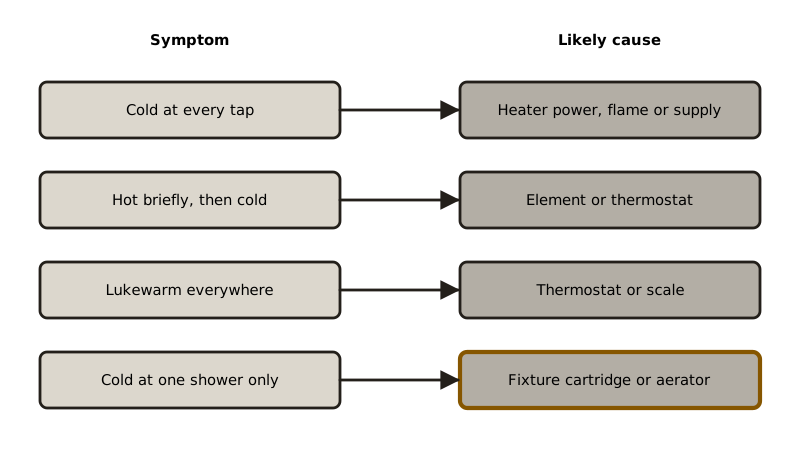
A fast way to sort it:
- Cold at every tap: heater has lost power, flame or its water supply.
- Hot briefly, then cold: a burnt element, a faulty thermostat or a heater too small for the load.
- Lukewarm everywhere: thermostat set low, one dead element, or a thick layer of scale.
- Cold at one shower only: a fixture problem, not the heater.
- Hot water that ran out mid-shower and never returned: a tripped limit switch or a failed igniter.
Before you touch a thing, check the floor beneath the tank. Standing water rewrites the plan, and fixing a water heater leak lists what to close first.
My heater is electric. Where do I look first?
The breaker comes first. A tripped double-pole breaker is a frequent reason an electric unit goes cold. Behind the upper access panel of an electric tank is a thermostat with a little red reset button. Popped? Press it once, nothing more. If it trips again, a part is failing and a plumber should see it. Keep the heater's panels shut until the breaker is off.
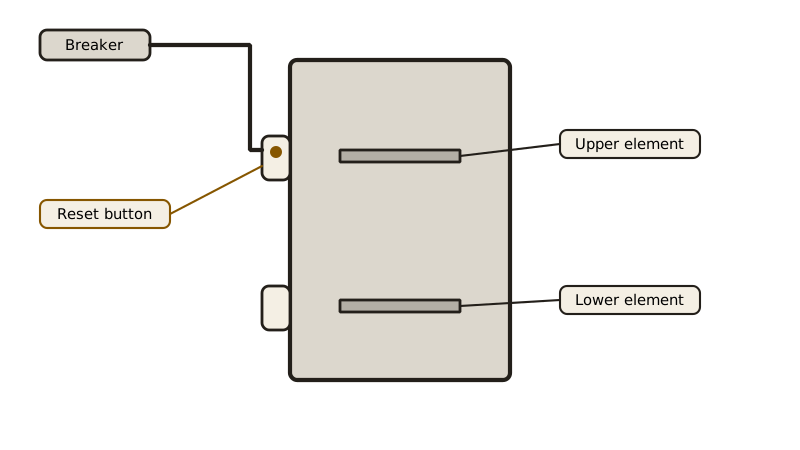
If the breaker and reset are fine, the next suspects are the heating elements and thermostats, which wear out. A dead lower element gives you a little hot water that disappears quickly; a dead upper element can mean no hot water at all. Testing them needs a meter and live-circuit care, so this is where most homeowners hand it over. Element swaps get their own write-up: replacement water heater element.
What causes no hot water in a gas water heater?
Gas heaters need three things: gas supply, a flame and a working safety circuit. Confirm the gas control valve is open and the dial sits at "on" or "pilot." With the pilot out, the label or manual gives the relight sequence. Pilots that keep dying soon after lighting tend to blame an aging thermocouple or a draft.
Gas safety comes first. A gas odor at any step ends the DIY. Smell gas and you leave the building before anything else. From outdoors, SoCalGas answers at 1-800-427-2200, and a person in genuine danger gets 911. Skip any relight attempt while the odor lingers. Under state rules, gas pipe and valve repairs go to a contractor. Many newer gas models skip the standing pilot and use an electronic igniter, so a dead igniter or a flame sensor coated with soot can also leave you cold.
If your heater is a Rheem, as with most brands, a small window or LED blinks a status code that the label or manual decodes. Note that code before you call, because a plumber will want it.
Why would a tankless heater, a boiler or an apartment system run cold?
Tankless units stop when they detect an error: no flow, a blocked vent, scaled-up heat exchanger, or lost gas or electric supply. Boilers and central apartment systems stop for similar reasons, plus a pump or building-wide valve problem. A boiler is the less likely case, since tank heaters dominate in single-family houses.
On a tankless unit, read the error code on the display, then inspect the inlet screen and the isolation valves. Water in this area is moderately hard to hard: Cucamonga Valley Water District's 2025 report puts total hardness at 109 to 142 ppm, while Upland's 2024 report averages 163.42 ppm. Scale from hard water collects on heat exchangers, and tankless units dislike it. Fixes for these units are in tankless repair, and a choice between types is weighed in tank vs tankless.
In an apartment, a shared boiler or a central heater outage is the building's problem, not yours. Tell the manager in writing and ask for a timeline. If only your unit is cold and you have your own heater, the electric and gas checks above apply, but you may need the landlord's permission to call anyone.
Should I treat this as urgent?
It is usually inconvenient rather than hazardous. Call right away if you see water leaking from the tank, smell gas, hear banging or hissing from the heater, or see scorch marks. Those are emergencies. By itself, cold water is irritating but safe, and it can generally wait for a weekday visit.
Escalate when a leak is active, water is reaching electrical gear, or the relief valve is discharging. At the heater, shut the cold inlet valve first, then power down: breaker off for electric, gas control to off for gas. Then read emergency water heater repair. A relief valve that drips has its own page: relief valve replacement. An old tank that has no anode protection left may rust out, which is why the anode rod guide is worth a read.
Whom do I ring about a dead water heater?
Call a plumber if the breaker keeps tripping, the reset pops again, a gas pilot will not stay lit, or the tank is leaking. A plumber can replace elements, thermostats, valves and, when the tank has failed, the whole heater. Call the gas utility for a gas smell, and the building manager if you rent.
The visit comes from a nearby plumber we line up for you. On the request form, give the heater type, its age, what you have tried and any codes, so the visit starts from facts. Before any work starts, you get a written quote. New heaters are generally permitted work. In Rancho Cucamonga that means an online application to Building and Safety. Phones are answered during weekday office hours, 9 to 5.
Common questions
How quickly will the shower run warm again?
Resets and pilot relights are quick, a matter of minutes. Elements and thermostats may be done in one visit when the plumber has the right part. A whole new heater takes longer: drain, remove, set, connect, test, permit. The written quote should lay out the plan and what the price covers.
What belongs in a water heater quote?
Check that the quote spells out the permit, taking away the old tank, strapping and venting. Also confirm the contractor's California license number. Permitted work, or a job totaling $1,000 or more, brings the license requirement; cslb.ca.gov has the lookup.
Can I be out during the heater work?
Better not. A person must open the door, point to the heater and agree the scope of work. Expect no water for part of the visit and plan showers around that. Renters may need landlord approval first, and boxes should be moved away from the heater beforehand.
Why is my hot water running out so fast?
Candidates include a dead lower element, a thermostat dialed low, sediment crowding the tank, or a heater undersized for your household. Hard water builds scale faster, which is why tank flushing is routine upkeep. For a recent change, a plumber would test the elements first.
Can I light or reset the heater myself?
A reset button, a breaker and the manual's pilot steps are fair game when nothing smells of gas. Opening the electrical compartment, disconnecting gas or relighting again and again is where the risk begins. If unsure, shut everything off and call.
This guide is one of many on Cucamonga Peak Plumbing.
Updated