Pop the ceramic lid off the tank and just watch for a moment. If water spills into the tall open tube in the middle, the fill valve never shuts. If the level slowly sinks and the toilet tops itself up on its own, the rubber flapper at the bottom is leaking into the bowl. Those two cover most cases, and the parts cost little. Everything about the fixture overall lives on the toilet service page; this one deals only with the endless running. Prefer to hand it off? If you would like a pro, we book the visit with a local plumber, and you read the price before any work.
What does the noise or the pattern point to?
Pair the behavior with the part. Steady hissing from a full tank implicates the fill valve. A brief refill every few minutes when nobody has been near is the so-called phantom flush, and it blames the flapper. If it quiets only when you wiggle the handle, the chain is catching. Water sliding down the open tube means the float sits high.
Each pattern has its own repair, so guessing wastes parts and money. The table pairs them.
| What you notice | Likely part |
|---|---|
| Hissing, tank full | Fill valve or its seal |
| Refills now and then, nobody flushed | Flapper or its seat |
| Quiets when the handle is wiggled | Chain too tight or too slack |
| Water reaching the open tube | Float or fill valve height |
| Dyed water seeping into the bowl | Flapper |
Is the flapper the part that leaks?
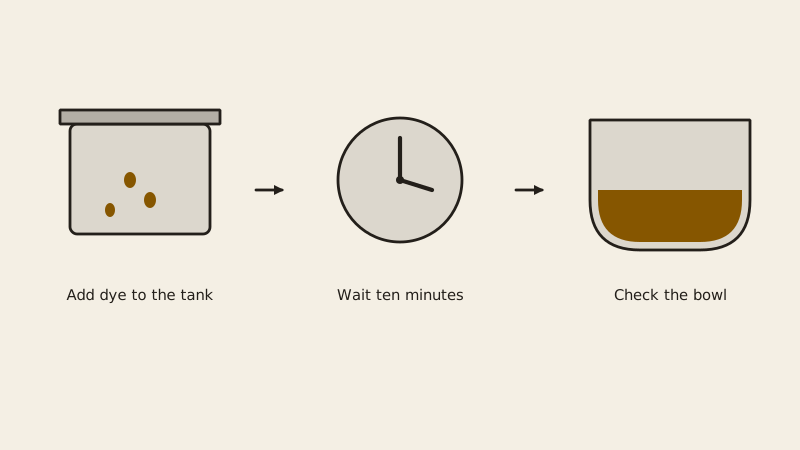
Yes, and it needs only food dye. Squeeze a little blue or red coloring into the cistern and then ignore the toilet for a quarter hour, handle untouched. A stained bowl afterward proves the seal is failing. Before buying parts, scrub the rubber and its seat with a rag, because film and grit can prevent a proper close.
Local water explains why. The Cucamonga Valley Water District's 2025 report lists an average hardness of about 125 ppm, and the City of Upland's 2024 report shows 163 ppm for its system. Water in that range leaves chalky deposits on flapper seats. If wiping fails, replacing the flapper is a ten-minute errand with an inexpensive part.
The tank level keeps creeping up the overflow tube. Why?
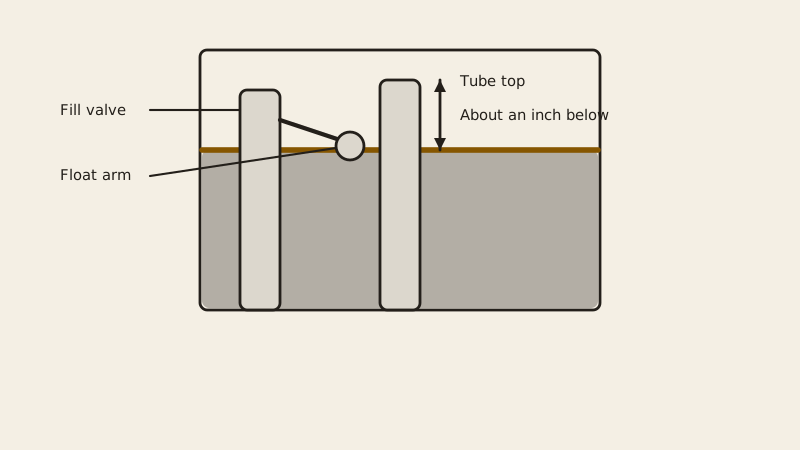
Two culprits fit: a fill valve that cannot shut, or a float perched too high. Lower the float, and see if the valve shuts off with the water about an inch beneath the top edge of the tube. A valve that hisses even at the lowest setting is spent and needs replacing, not adjusting.
Plenty of homeowners handle the swap. Order of work: turn off the angle stop, flush to drain the cistern, mop the dregs, unscrew the supply line, fit the new valve, reconnect. Detail on every step sits in fill valve repair for toilets. Water that appears on the floor, though, is a different problem, and fixing a toilet leak covers it.
Will a bottle of liquid drain opener help a toilet that runs on?
It will not. Running is not a clog, so there is nothing for the chemical to dissolve, and the product can harm the bowl glaze and sting whoever has to open the trap down the line. Many labels steer buyers to sink drains, so read before pouring. Never combine two cleaners, since the fumes can hurt you.
Products like liquid Plumr are meant for slow drains. A toilet that both runs and flushes sluggishly has two separate issues. Where a blockage is part of the trouble, a toilet-specific plunger or a hand-cranked closet auger will outperform chemicals, and clearing a blocked toilet describes the chemical-free route.
What does a nonstop toilet cost me in water?
Plenty, and silently. Per the EPA, leaks in a typical household lose upward of 9,300 gallons annually, and flapper failure ranks among the usual causes. If the toilet tops itself up several times an hour, a jump on your next water bill would not be a surprise.
When the bill jumps but the toilet is quiet, widen the search to the meter and the other fixtures. High water bills and what causes them lists the usual suspects, and the dye test costs nothing.
What parts and tools does the usual fix call for?
Usually a universal flapper, or a fill valve kit, and an adjustable wrench. A towel and a small sponge help with the last water in the tank. Match the flapper to your tank: some toilets take a two-inch flapper and others a three-inch one, and a mismatch causes the very leak you are chasing.
Carry the worn flapper into the hardware aisle to compare, or jot down the maker and model number molded into the tank. Keep the receipt. A new part that also leaks points to a pitted seat, which fine sandpaper sometimes smooths and which otherwise needs a new flush valve.
When should the screwdriver go back in the drawer?
Stop if any part is cracked, the supply shutoff will not close, the line beneath the tank weeps at its nut, or the running persists even though a fresh flapper and a fresh fill valve are already in. An older toilet can also have a worn flush valve seat, which a rubber part cannot repair.
The options then are a new flush valve assembly or a new toilet, and a plumber can price each during the visit. To gauge the second route, look at toilet replacement pricing. If you are chasing a backup rather than a leak, clogged toilet service suits that better.
Common questions
Can I get this done before lunch?
A flapper or fill valve job tends to fit inside an hour for most homeowners, shopping included, and a plumber needs similar time on site plus the drive. A frozen shutoff, or a toilet that has to come off its flange, stretches it. Running the dye test first saves a return trip.
What do I ask when a plumber gives me a price?
Check that parts are included, that a worn flapper and a worn fill valve both get replaced, and that the shutoff under the tank is tested. Get the figure on paper in advance, and ask how the price shifts if the toilet itself is at fault.
Will somebody have to stay home for the appointment?
An adult should open up and indicate which bathroom. After that the work is brisk and rarely needs supervision. Clear the floor around the base and find the shutoff beforehand. You can approve any extra part or repair before it goes in.
The rest of our guides start from plumber rancho cucamonga.
Updated